A sharp pain along the inner side of your knee after a twisting motion, a direct blow, or landing awkwardly usually points to the medial collateral ligament. MCL sprain recovery time varies widely depending on how severe the tear is, but most active adults are back to normal activities within one to eight weeks, often without surgery. This guide covers what the MCL does, how recovery breaks down by grade, and what physical therapy looks like along the way. Our team at Scottsdale Physical Therapy & Performance treats knee pain like this every week.
What Is the MCL and Why It Gets Injured
The medial collateral ligament (MCL) runs along the inner side of your knee joint, connecting your thigh bone to your shin bone and providing knee stability against side-to-side forces. It’s one of the most commonly injured knee ligaments, and it shows up often in sports injuries involving pivoting, cutting, or contact. Most MCL injuries happen from a direct blow to the outer knee, a form of direct trauma that forces the inner side of the knee joint to stretch, or from a non-contact twisting motion where the knee buckles inward. Golfers can sprain it during an aggressive swing rotation, and weightlifters sometimes injure it under load during squats or lunges with poor knee tracking.
MCL Sprain Recovery Time by Grade
MCL injuries are graded on a 1-to-3 scale, and the grade drives almost everything about your treatment plan and recovery timeline. Your age, your overall health, and whether the anterior cruciate ligament (ACL) or meniscus was hurt at the same time also affect how long healing takes.
- Grade 1 (mild sprain): A small number of ligament fibers are torn, which is why this is still called a mild sprain. Mild pain and tenderness along the inner knee, minimal swelling, and the knee remains stable. Recovery typically runs 1 to 3 weeks.
- Grade 2 (partial tear): The ligament is partially torn, with more fibers damaged than in grade 1. More noticeable pain and swelling, some knee instability when testing side-to-side movement, and possible bruising. Recovery typically runs 2 to 4 weeks.
- Grade 3 (severe or completely torn): A torn MCL at this grade means the ligament is completely torn. Expect significant swelling, clear knee instability, and difficulty bearing weight. Recovery usually takes 4 to 8 weeks, and surgery is still uncommon for an isolated MCL tear.
Symptoms of an MCL Sprain
Beyond pain along the inner side of the knee, watch for swelling that develops within hours of the injury, a feeling that the knee might give way when you plant or pivot, and tenderness directly over the ligament when pressed. Most MCL tears heal well without surgery because the ligament has a good blood supply. A physical exam alone often tells an MCL sprain apart from other knee injuries. If the physical examination isn’t conclusive, or a doctor wants to rule out an ACL or meniscus tear at the same time, magnetic resonance imaging (MRI) can show how much of the ligament is torn. If you’re unsure whether your knee pain warrants professional attention, our guide on when to see a physical therapist for knee pain walks through the warning signs in more detail.
Treatment for an MCL Sprain: When MCL Surgery Is (and Isn’t) Needed
In the first few days, the priority is protecting the ligament and reducing swelling. Rest, ice, compression, and elevation form the foundation, along with a hinged knee brace for grade 2 and 3 sprains to protect against side-to-side stress while the ligament heals. Most orthopedic surgeons and sports medicine specialists treat MCL sprains non-surgically, because the ligament heals well when it’s protected early and rehabbed properly. Most isolated MCL tears don’t require surgery. Surgery is generally reserved for severe cases involving multiple ligament tears (an MCL tear alongside a torn ACL or lateral collateral ligament, for example) rather than an isolated MCL injury. When surgery is needed, the surgeon either reattaches the torn ligament or reconstructs it, sometimes with a graft. How closely you stick to the brace and activity restrictions in this early phase has a big say in your MCL injury recovery time and whether the ligament ends up fully healed.
How Physical Therapy Helps MCL Recovery
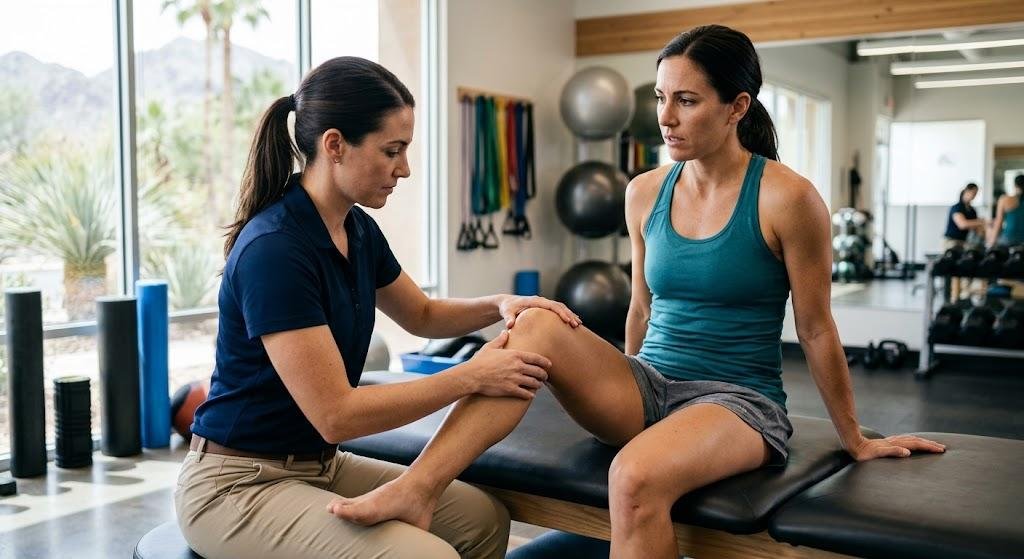
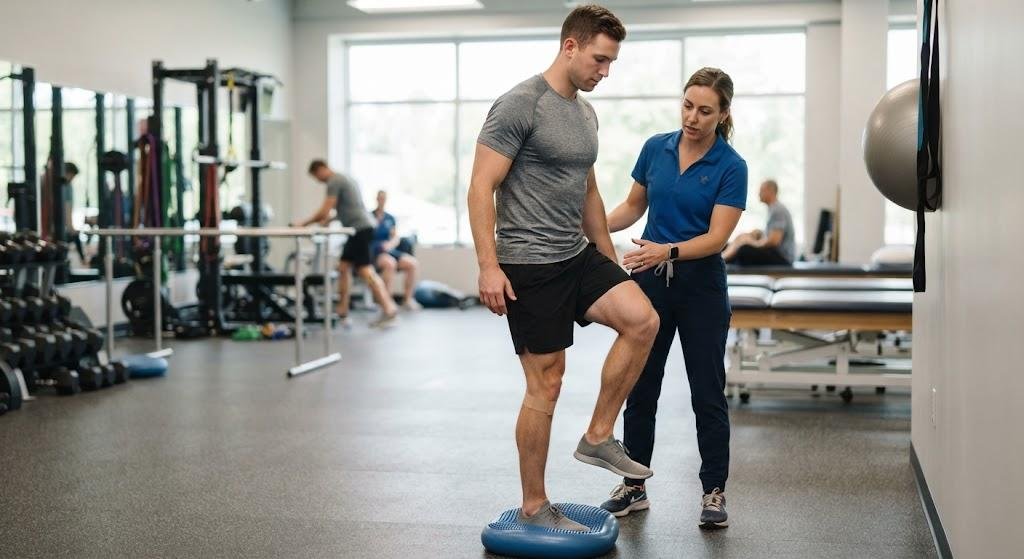
Physical therapy exercises are what rebuild knee strength and range of motion once the acute swelling has settled, and returning to activity before this stage is done raises your risk of re-injury. A physical therapist starts you with gentle range-of-motion work, then moves to closed-chain strengthening like squats and step-ups, which builds stability around the joint without stressing the healing ligament. The last stage adds sport-specific movements like cutting, pivoting, or a golf swing before you’re cleared for full return to activity. This staged approach matters because a knee that regains motion but not strength, or strength but not stability, is far more likely to re-injure the same ligament under load.
How Scottsdale Physical Therapy & Performance Approaches MCL Recovery

At Scottsdale Physical Therapy & Performance, we want you to trust your knee again under the demands of your sport, and being pain-free is only part of that. Our return-to-sport approach for golfers builds you back up to a full swing before you’re cleared. For weightlifters, that means confirming your squat and lunge mechanics protect the ligament under load, since a knee can bend without pain and still be unstable. We build each plan around the activities you want to get back to, not a generic recovery timeline, and we aim to keep you out of surgery and on the sidelines no longer than necessary.
Not sure which grade you’re dealing with? Schedule an evaluation or reach out to our team, and we’ll look at your knee, talk through your sport, and map out your next steps.
Frequently Asked Questions
How Do You Heal a Sprained MCL Fast?
There’s no real shortcut past the ligament’s own healing timeline, but staying consistent with RICE in the first few days followed by progressive physical therapy exercises gets you back to normal activities as fast as the grade of injury allows. Rushing back to full activity before the ligament and surrounding muscles are ready tends to set recovery back further.
How Long Should You Rest a Sprained MCL?
Complete rest is really only needed for the first few days after injury. After that, gentle movement and physical therapy support healing more than continued rest does, since the knee needs to regain range of motion and strength rather than just sit still. A knee specialist or physical therapist can tell you when it’s safe to progress.
How Do You Tell If an MCL Is Torn or Sprained?
A sprain is a tear of the ligament fibers, so the real question is how much is torn. A mild sprain (grade 1) usually means tenderness along the inner knee that you can mostly walk through, with the knee remaining stable. A more significant tear (grade 2 or 3) typically comes with visible swelling, a sense of knee instability when you pivot or plant, and sometimes bruising. If you’re not sure which you’re dealing with, a physical exam can usually tell the difference.
Is It Okay to Walk on a Sprained MCL?
For a mild sprain, yes. Gentle walking as tolerated usually doesn’t harm the healing ligament. For a grade 2 or 3 injury, a hinged knee brace and possibly crutches in the first few days help protect the knee from side-to-side stress while it starts to heal, and a physical therapist can guide when to progress off them.