If your knee aches every time you walk up stairs, or it stiffens up before you even get out of bed, you’ve probably already tried the basics: ice, rest, maybe an anti-inflammatory or two. Red light therapy for knee pain has become one of the more talked-about options for people who want relief without leaning on medication or facing surgery right away.
Whether you’re dealing with arthritis that flares after a round of golf, a runner’s knee that won’t fully calm down, or general wear and tear that’s crept up over the years, it’s worth understanding what this treatment actually does before you try it. The interest isn’t hype for hype’s sake. There’s a real, growing evidence base behind it, drawn from clinical research rather than anecdotes alone.
This isn’t a miracle cure, and anyone who tells you otherwise is overselling it. But for a lot of active adults in Scottsdale, it’s become a genuinely useful piece of a bigger recovery plan, especially when it’s paired with the kind of targeted treatment a physical therapist can offer.
What Red Light Therapy Actually Does for Your Knee
Red light therapy, sometimes called low level laser therapy or photobiomodulation, uses specific wavelengths of red and near infrared light to interact with your cells. The light penetrates through skin and soft tissue and reaches the mitochondria inside your cells, where it interacts with the enzymes driving cellular energy production.
When that energy production gets a boost, cells can repair themselves more efficiently. Inflammatory signaling tends to calm down as well, which is a big part of why this approach shows promise for joint conditions in the first place.
For a joint like the knee, that mechanism matters because so much of the discomfort you feel comes from inflammation and swelling around the joint tissue, not just mechanical wear on its own. Near infrared light penetrates deeper than visible red light, which makes it more effective for reaching structures like the joint capsule, tendons, and surrounding cartilage rather than just the surface of the skin.
Research shows that specific wavelengths of red light therapy may reduce inflammatory activity at the cellular level and support tissue repair, in ways that go beyond simply numbing pain. It’s a fundamentally different mechanism than medication. Traditional treatments like anti-inflammatories often mask symptoms rather than address the underlying inflammation driving them, while light therapy is aimed at the cellular process itself.
The light also appears to improve local circulation by triggering the release of nitric oxide, which relaxes blood vessels and increases blood flow to the treated area. Better blood flow means more oxygen and nutrients reaching the joint tissue that needs to repair.
That improved circulation also helps clear out some of the byproducts of inflammation that tend to accumulate around an irritated joint. Over time, that combination of reduced inflammation and better circulation is what drives the pain relief patients typically report.
Not every red light therapy device delivers the same results. Led light therapy panels and dedicated low level laser therapy devices vary widely in power output, and the dose you actually receive depends on the wavelength, the intensity, and how long you stay under the light.
None of this replaces a diagnosis. If your knee pain came on suddenly, is accompanied by significant swelling, or you can’t bear weight on it, that’s a conversation for a physical therapist or physician before you consider any at-home or in-clinic treatment.
Common Causes of Chronic and Post-Workout Knee Pain
Knee pain rarely comes from one single thing, and figuring out what’s behind yours changes which treatment options make sense and how fast you can expect results.
Knee Osteoarthritis
Osteoarthritis is one of the most common reasons active adults develop chronic knee pain, especially as cartilage degeneration builds up from years of training, running, or simply aging. Knee osteoarthritis pain tends to build slowly, often starting as mild stiffness after activity and progressing into a more constant ache over months or years.
It’s also one of the conditions with the strongest evidence base behind red light therapy as a supportive treatment, which we’ll get into shortly. Multiple randomized controlled trials have specifically studied knee OA, which is part of why it’s become one of the better-understood applications of light therapy for joint pain.
Runner’s Knee and Patellofemoral Pain
If you run, cycle, or do a lot of squatting and lunging, you may be dealing with patellofemoral pain, commonly known as runner’s knee. This usually develops from repetitive stress on the kneecap combined with muscle imbalances in the hip and quad that change how the kneecap tracks during movement.
It tends to flare with activity and ease with rest, which makes it frustrating for anyone who doesn’t want to stop training altogether. Left unaddressed, this pattern can turn into a chronic knee condition that limits training volume for months at a time.
Tendinopathy and Overuse
Tendon irritation around the knee, particularly at the patellar tendon, shows up frequently in golfers, weightlifters, and CrossFitters who load the knee repeatedly without enough recovery time. This kind of overuse injury tends to build gradually and often gets dismissed as “just soreness” until it starts limiting how much weight you can load or how deep you can squat.
Tendon tissue also heals more slowly than muscle, since it has a more limited blood supply. That’s why tendinopathy can drag on for months without a targeted plan.
Post-Surgical or Ligament-Related Knees
Whether you’re recovering from a meniscus repair, an ACL reconstruction, or a total knee replacement, the knee goes through a significant inflammatory response after surgery. That inflammation is a normal part of healing, but managing it well can make a real difference in how smoothly your rehab progresses.
Ligament sprains and meniscus injuries create a similar inflammatory cascade even without surgery. The joint swells, range of motion drops, and the surrounding muscles often tighten up protectively, which is its own separate problem to work through.
Symptoms and How They Limit Your Movement
Knee pain doesn’t just hurt. It changes how you move, and for an active adult or athlete, that’s often the part that’s hardest to accept.
Morning Stiffness and Warm-Up Pain
Many people with chronic knee conditions notice the joint feels tight and achy first thing in the morning or after sitting for a while, then loosens up once they get moving. This stiffness is a hallmark of osteoarthritis and can make the first few minutes of a workout genuinely uncomfortable.
For golfers especially, that stiffness can affect your swing before you’ve even reached the first tee, since a knee that isn’t moving freely changes how your hips and lower body rotate.
Swelling After Activity
A knee that swells after a run, a lift, or a round of golf is telling you something. Post-exercise swelling usually points to irritated soft tissue or an inflamed joint lining, and if it happens consistently, it’s worth addressing rather than icing and hoping it goes away.
Swelling that lingers for more than a day or two after activity is a sign the joint isn’t recovering as quickly as it should between sessions, which often means the training load and the recovery plan are out of balance.
Instability on Stairs, Squats, or Lateral Movement
Pain and swelling often bring a sense of the knee feeling unstable, especially going down stairs, during deep squats, or when cutting side to side. That instability isn’t always about the ligaments themselves.
Sometimes it’s the surrounding muscles guarding against pain, which limits how confidently the knee can bear load. Over time, that guarding pattern can become its own limitation, separate from whatever caused the pain to begin with.
How Red Light Therapy Fits Into Knee Pain Treatment
Once you know the underlying cause, red light therapy gets layered into a broader treatment plan rather than used on its own.
What a Session Actually Involves
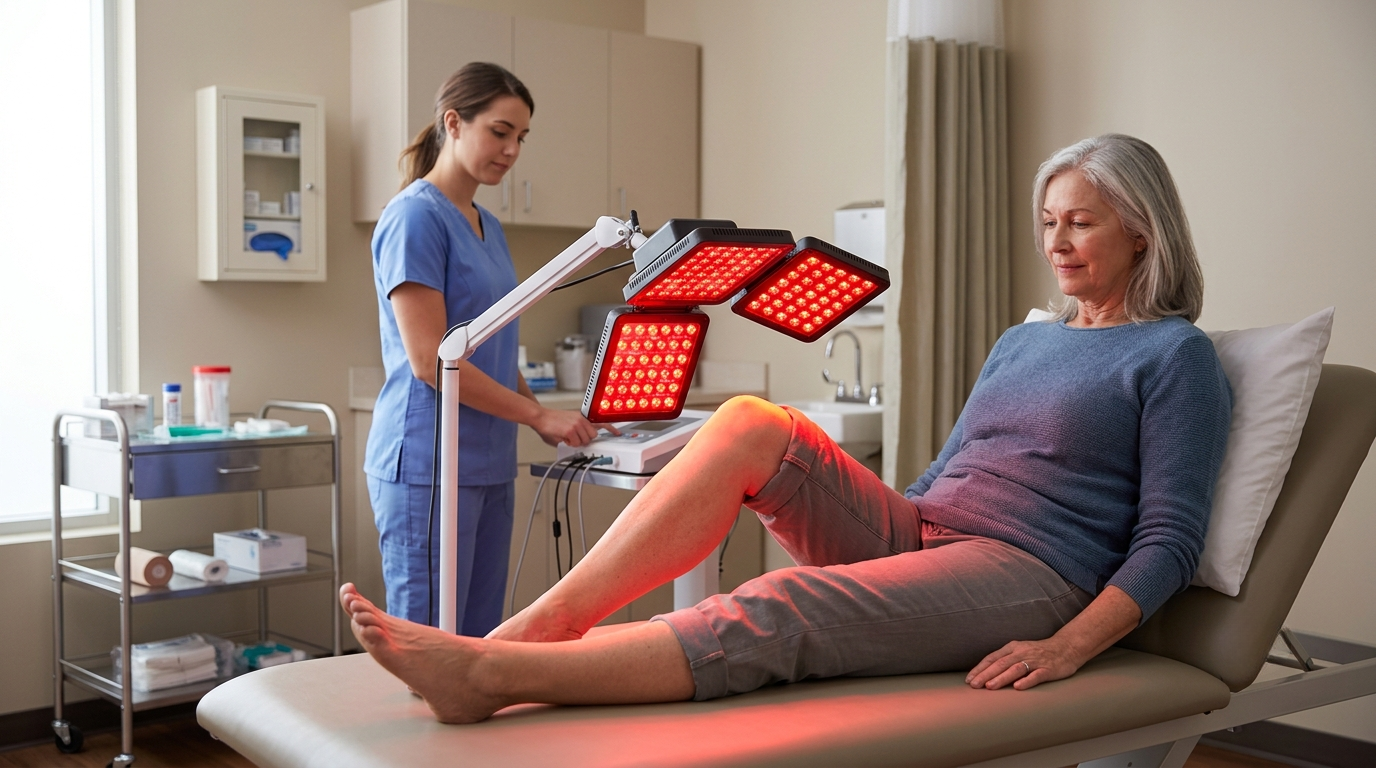
A typical session involves positioning a red light therapy device directly over the knee for somewhere between ten and twenty minutes. There’s no discomfort involved, and there’s no downtime afterward.
Most people describe it as a mild, pleasant warmth rather than anything uncomfortable. That makes it easy to fit before or after a workout, or as part of a physical therapy visit.
Wavelengths and Dosing That Matter
Not all light therapy for knee pain is created equal, and this is where a lot of the confusion around red light therapy comes from. The research consistently points to wavelengths in the 660 to 808 nanometer range as effective for knee pain, with some studies showing benefit extending into the 785 to 860 nanometer window for reaching deeper joint tissue.
Energy density in the range of 4 to 8 joules per centimeter squared, delivered consistently, is the dosing sweet spot that shows up again and again in clinical research on knee osteoarthritis pain. Power output and treatment duration both factor into whether a given session actually delivers that dose, which is part of why clinical-grade equipment tends to outperform lower-powered home devices.
Realistic Timelines
Consistency matters more than any single session. Most research protocols involve somewhere between ten and sixteen sessions, often three to five times per week, before meaningful pain reduction shows up.
Some patients report noticing a difference within four to six weeks of consistent use, with more complete results building over eight to twelve weeks. A 2019 meta-analysis pooling data from over a thousand patients found significant improvement in knee osteoarthritis pain, with effects that held up across multiple randomized controlled trials.
That kind of evidence base, drawn from a systematic review of numerous studies rather than a single small trial, is part of why red light therapy has moved from a fringe idea to something more clinics are willing to offer. Growing evidence continues to support its use as part of a broader pain management approach, though researchers are clear that more research helps refine exactly which patients benefit most.
Why Physical Therapy Still Does the Heavy Lifting
Red light therapy can calm inflammation and support tissue repair, but it doesn’t correct the movement patterns, strength deficits, or mobility restrictions that usually caused the knee pain in the first place. Physical therapy is what corrects those problems.
A thorough PT evaluation looks at how your hip, ankle, and core are contributing to what’s happening at the knee joint, not just the knee itself. From there, a treatment plan typically targets the specific muscle groups that aren’t doing their job.
That might mean weak glutes letting the knee cave inward during a squat or tight quads pulling unevenly on the kneecap during a run. Either way, identifying the actual mechanical cause is what separates a treatment plan that lasts from one that just manages symptoms.
Red light therapy earns its keep here, as an adjunct rather than a replacement. Reducing pain and inflammation makes it easier to tolerate the strengthening and mobility work that actually addresses the root cause of your knee pain.
Red light therapy can be combined with physical therapy for meaningfully better outcomes than either approach used alone. That combination is more effective than counting on light therapy alone to solve what is, at its core, a mechanical and strength problem.
For patients recovering from a total knee replacement or another surgical procedure, that same principle applies. Managing inflammation well in the early weeks can make the rehab process considerably smoother.
Even so, the actual restoration of strength and range of motion still depends on targeted therapeutic exercise, progressed carefully over the following months. There isn’t a shortcut around that part of recovery, and any clinic that suggests otherwise isn’t giving you the full picture.
How Scottsdale Physical Therapy & Performance Approaches Knee Pain
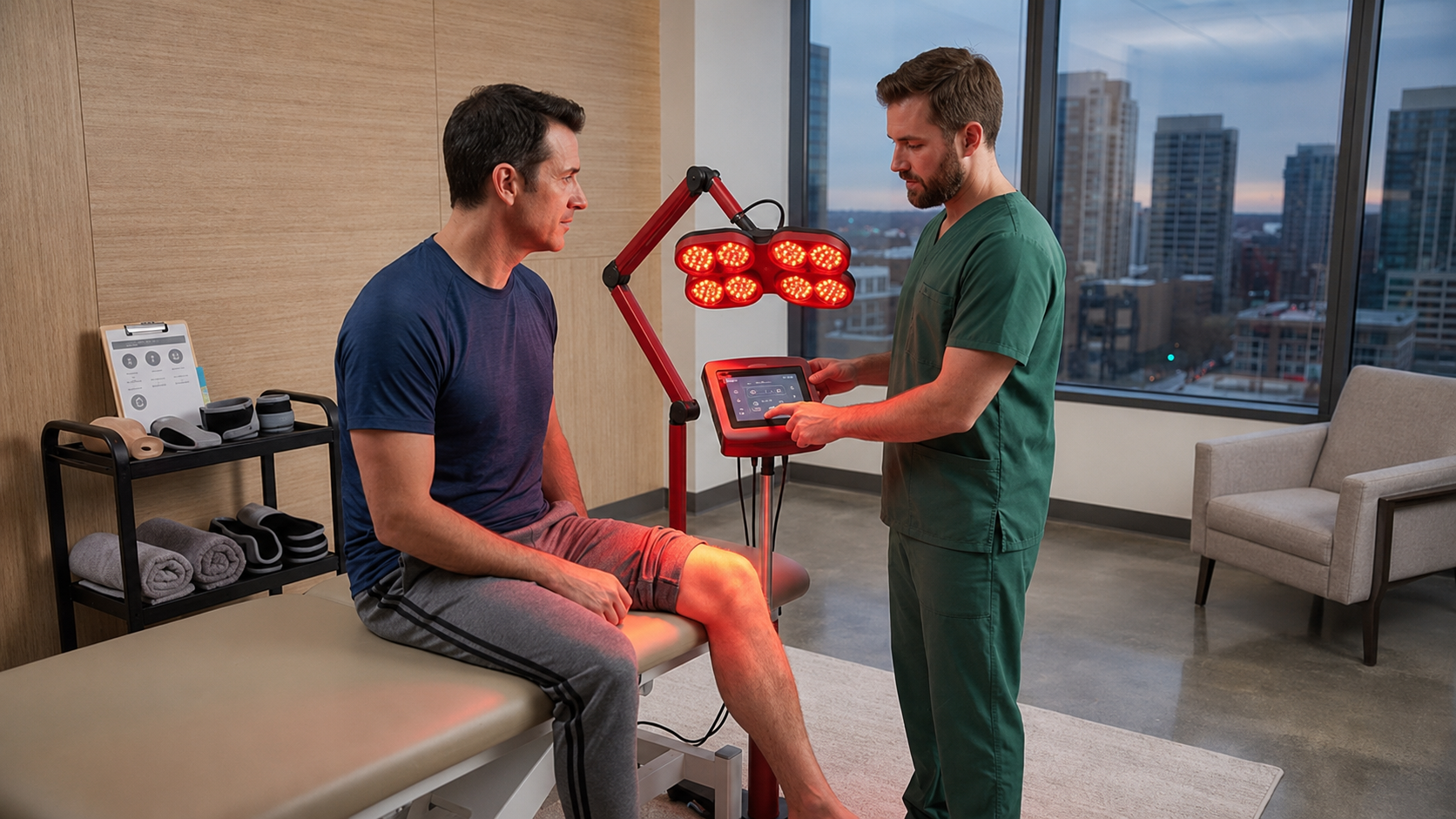
At Scottsdale Physical Therapy & Performance, red light therapy is one tool among several, never the whole plan.
Red Light Therapy Sessions
Our clinical-grade red and near infrared system is available as a standalone session or paired with an evaluation, giving patients an easy way to add it into their recovery routine without adding much time to their week. Sessions are quick and relaxing, and they require no downtime.
That makes it realistic for someone squeezing recovery into a schedule that already includes work, training, and everything else. Whether you’re coming in specifically for knee pain or adding it onto another visit, the process stays simple.
Pairing It With Your PT Plan
For patients working through a full rehab program, whether that’s for knee osteoarthritis, a tendon issue, or post-surgical recovery, red light therapy typically gets layered in alongside manual therapy and a progressive strengthening plan. The approach stays consistent: reduce the pain and inflammation getting in the way, then use that window to make real progress on strength and movement quality.
Our therapists coordinate timing so the light therapy session supports the harder work happening in the same visit, rather than existing as a separate, disconnected add-on.
Personal Training and truFlex for Long-Term Knee Health
For athletes and active adults who’ve worked through the acute phase and want to build long-term resilience in the knee, our personal training and truFlex neuromuscular activation programs pick up where rehab leaves off. truFlex specifically targets the connection between your nervous system and the muscles supporting the knee, which matters a great deal for people whose knee pain stems from muscles that simply aren’t firing the way they should.
That neuromuscular piece often gets overlooked. You can strengthen a muscle in the gym and still have it fail to activate properly during a real-world movement like a golf swing or a sprint, and that gap is exactly what truFlex is designed to close.
Whether you’re trying to get back to golf, running, or the gym without your knee holding you back, this next phase is where a lot of the lasting change happens. It’s the difference between simply feeling better and actually moving better under load.
Knee pain doesn’t have to mean giving up the sport or workout you love, and it doesn’t have to mean jumping straight to surgery either. If you’re dealing with chronic knee pain, a stubborn tendon issue, or you’re just curious whether red light therapy makes sense for your situation, reach out to our team.
A quick conversation with a physical therapist can help you figure out whether this fits into your recovery, and what a realistic plan looks like from here.
Frequently Asked Questions
Is Red Light Therapy Safe for Knee Pain?
Yes, red light therapy is generally considered safe and non-invasive when used correctly. It doesn’t involve UV rays, doesn’t interact with medications, and carries no risk of systemic toxicity.
Some people notice mild warmth or slight redness at the treatment site, but that typically fades quickly. If you take medication that increases photosensitivity, it’s worth checking with your healthcare provider first.
How Many Sessions Before I Notice a Difference?
Most people using red light therapy consistently, around three to five sessions per week, start noticing a difference within four to six weeks. Full results tend to build over eight to twelve weeks of consistent use.
Sporadic, one-off sessions are unlikely to produce the same results as a consistent treatment schedule, since the effect appears to be cumulative rather than immediate.
Can I Use Red Light Therapy Instead of Physical Therapy?
Not if you want to fix the underlying cause of your knee pain. Red light therapy reduces pain and inflammation, which is genuinely useful, but it doesn’t correct the strength deficits, movement patterns, or mobility restrictions that usually created the problem.
The two work best together rather than as substitutes for each other, especially for anyone trying to return to a sport or training routine long-term.
Does Red Light Therapy Help Knee Osteoarthritis Specifically?
Yes, knee osteoarthritis has some of the strongest research behind it among the conditions red light therapy is used for. Multiple systematic reviews and meta-analyses have found meaningful reductions in pain and improved function for people with knee OA.
Those results are most pronounced when treatment is applied consistently over several weeks rather than used sporadically or as a one-time trial.
What Does a Session at Scottsdale PT Actually Feel Like?
Most patients describe it as a gentle, warm sensation with nothing uncomfortable about it. You’ll sit or lie comfortably while the device is positioned over your knee for the duration of the session, and you can go straight back to your day afterward with zero downtime.
Do I Need a Referral to Try Red Light Therapy at Scottsdale PT?
No. You can book a red light therapy session directly, and if you’d like it paired with a full evaluation to address the root cause of your knee pain, our team can walk you through what that looks like.
Arizona allows direct access to physical therapy, so you don’t need a physician’s referral to get started.