If you’ve had surgery, dealt with a lingering injury, or noticed a muscle that just won’t fire the way it used to, there’s a good chance your physical therapist has mentioned neuromuscular electrical stimulation, or NMES. It’s one of those clinical terms that gets used a lot but rarely gets explained well. You hear it, nod along, and still aren’t quite sure what’s actually happening when those electrodes go on your skin. That gap matters, because NMES isn’t just a buzzword or a gadget that makes your muscle twitch for the sake of it.
It’s a specific tool physical therapists use to reconnect your nervous system and your muscles when that connection has been disrupted. That disruption might come from a knee surgery, a spinal cord injury, or months of favoring one side of your body after an injury. This guide breaks down what NMES actually is, how it differs from other forms of electrical stimulation you may have heard of, and who it tends to help most. You’ll also get a clear picture of what to expect from a treatment plan that includes it, so you’re not just nodding along next time.
What Is Neuromuscular Electrical Stimulation?
Neuromuscular electrical stimulation is a technique that uses a device to send electrical impulses through electrodes placed on your skin, over a targeted muscle or the nerve that controls it. Those impulses mimic the signals your own nervous system would normally send to trigger a contraction. That external signal triggers the muscle to contract even when your brain isn’t able to fully activate it on its own. Think of it less like a passive massage tool and more like a workaround for a communication problem.
When a muscle is weak because it hasn’t been used correctly, or because the nerve signal telling it to fire has been interrupted, NMES steps in and forces that contraction directly. Over repeated sessions, this can help retrain the muscle and restore some of the natural nerve-to-muscle communication that got disrupted in the first place. The device itself typically has adjustable settings for frequency, pulse width, and intensity, since every muscle group and every patient responds a little differently.
Why Settings Are Customized to You
A physical therapist decides on those settings based on your specific condition, your tolerance, and what the muscle actually needs to accomplish. This is advanced technology, but the underlying idea is simple: get a muscle contracting again so it can start doing its job.
How NMES Differs From TENS
People often lump NMES in with TENS, or transcutaneous electrical nerve stimulation, since both use electrodes and both deliver an electrical current. The purpose behind each one is different, though. TENS is designed to interrupt pain signals before they reach your brain, and it isn’t meant to produce a visible muscle contraction. NMES is built to do the opposite. Its entire purpose is to create a strong, visible muscle contraction, not to manage pain directly.
You might use both in the same treatment plan for different reasons. TENS could help manage discomfort in the short term, while NMES works on rebuilding strength and muscle activation over the course of your recovery. A good physical therapist will explain which one you’re getting and why, rather than treating them as interchangeable. Knowing the difference helps you understand exactly what a given session is meant to accomplish.
Why Muscles Stop Firing Right
NMES wouldn’t be useful if muscles always contracted the way they’re supposed to. The reason this treatment exists at all comes down to a handful of situations where the connection between your brain and your muscles gets disrupted. In most of these cases, the muscle tissue itself is perfectly healthy. The problem sits somewhere between the brain, the nerve, and the muscle, not in the muscle fibers themselves.
Post-Surgical Muscle Inhibition
After a surgery like a total knee replacement or a total knee arthroplasty, it’s common for the surrounding muscles, especially the quadriceps, to essentially shut off. This isn’t because the muscle is damaged. It’s a protective reflex your nervous system triggers in response to swelling, pain, and the surgery itself, a phenomenon researchers call arthrogenic muscle inhibition. The result is a muscle that looks fine on paper but won’t fire on command, no matter how hard you try to contract it voluntarily.
This is one of the clearest use cases for NMES, since voluntary exercise alone often can’t get past that inhibition in the early weeks after surgery. The electrical impulse forces the contraction the brain won’t allow yet. That forced contraction helps prevent the muscle from wasting away while you’re waiting for that natural signal to come back online. The sooner a muscle stays active after surgery, the easier the rest of your recovery tends to go.
Disuse Atrophy From Immobilization
Anytime a joint gets immobilized, whether from a cast, a brace, or simply avoiding movement because of pain, the muscles around it start to shrink. This is called disuse atrophy, and it can happen faster than most people expect. A muscle that isn’t being asked to contract regularly loses both size and strength. That loss then makes it even harder to move that joint normally once you’re cleared to start rehab.
NMES gives that muscle a reason to contract even while you’re still restricted from full activity. It won’t replace the strength you’d build through normal training, but it can meaningfully slow the loss of muscle mass and function during a period when your options are limited. There’s also a circulation benefit worth mentioning here. For patients who are immobilized after surgery or injury, keeping muscles contracting can support blood flow in the treated limb, which is one reason NMES sometimes comes up in conversations about reducing the risk of complications like deep vein thrombosis during periods of limited movement.
Neurological Involvement
For patients dealing with a spinal cord injury, a stroke, or a condition like cerebral palsy, the issue isn’t inhibition from swelling or pain. It’s a more direct disruption in how the brain and peripheral nerves communicate with the muscle. In these cases, NMES is often used to help with motor re-education. It essentially helps retrain the neuromuscular pathway by repeatedly producing the movement pattern the brain is struggling to initiate on its own.
This use of NMES tends to be more involved and requires closer supervision, since the goals and progression look different than a straightforward post-surgical recovery. A physical therapist working with neurologically impaired patients will typically pair NMES with functional tasks. Standing, walking, and reaching are common examples, rather than isolating a single muscle group the way you might with a post-surgical knee. The stimulation supports a functional movement pattern, not just an isolated twitch.
What NMES Treatment Actually Looks Like
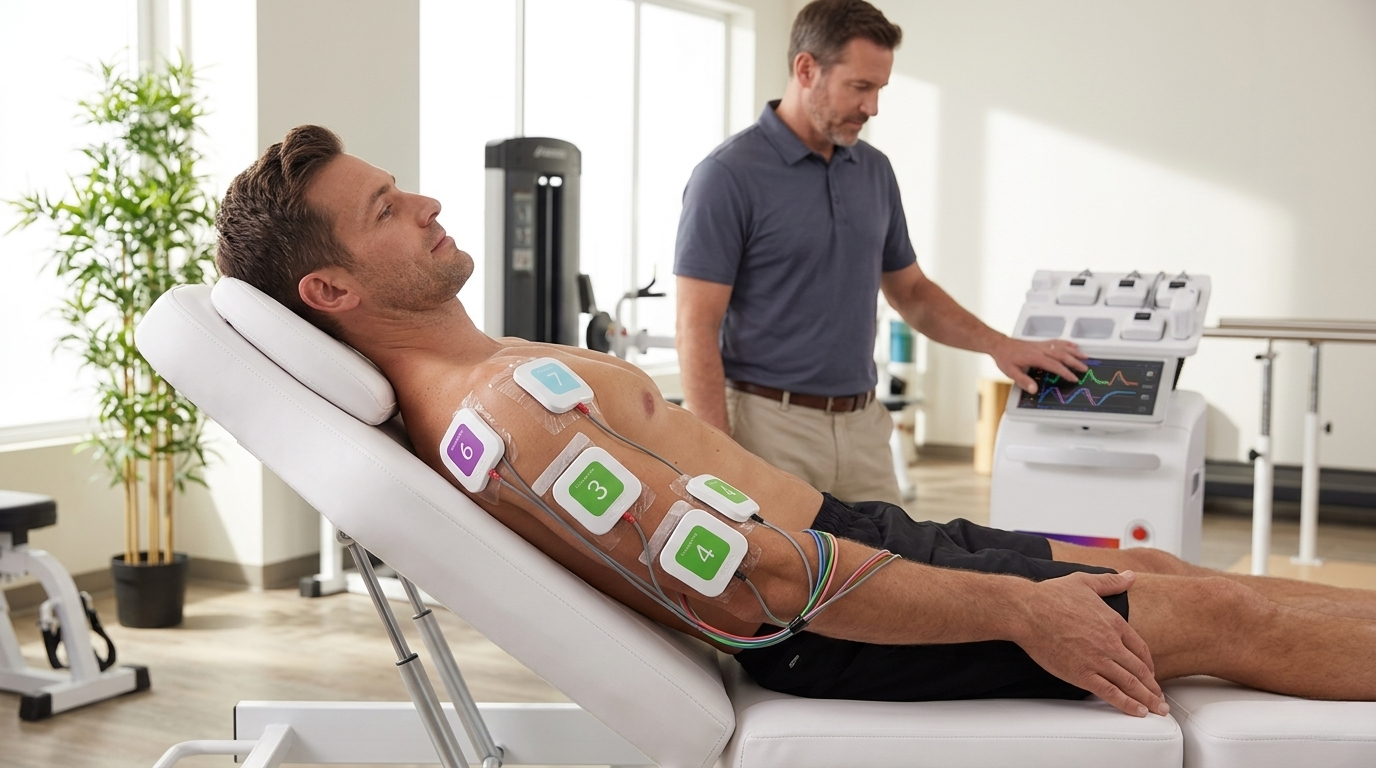
If you’re picturing something dramatic, the reality is more manageable than people expect, though it isn’t always painless. Electrodes get placed directly over the targeted muscle or its motor nerve.
Electrode Placement and Session Basics
The device then delivers a series of electrical impulses in a pattern designed to produce a strong, controlled contraction. Where exactly the electrodes sit matters, since placement over the wrong spot won’t recruit the muscle effectively no matter how strong the current is. Most protocols use a frequency somewhere between 30 and 50 Hz, since that range tends to optimize how many muscle fibers get recruited during each contraction. Pulse width is typically set between 400 and 600 microseconds.
The device cycles between an “on” period, where the muscle contracts, and an “off” period where it rests. A 1:5 on-to-off ratio is common, giving the muscle enough recovery time between contractions to avoid excessive fatigue.
Intensity, Discomfort, and Dosage
Intensity matters more than most people realize. Research suggests you need a stimulation level of at least 20 percent of your maximum voluntary contraction to see a meaningful training effect. Higher intensities, sometimes reaching around 50 percent of maximum voluntary contraction, tend to produce better strength gains. The tradeoff is that higher intensity generally means more discomfort during the session.
It’s fair to expect some level of discomfort or even mild pain during a session, especially as intensity increases. High-intensity NMES can be uncomfortable but still highly effective, and finding the right balance is part of your physical therapist’s job. A dose has to be strong enough to matter, but also one you can actually tolerate and stick with. If a treatment protocol is too uncomfortable, patients tend to disengage from it, and low adherence undercuts the whole point of using it in the first place.
Some muscle soreness in the day or two after a session, sometimes lasting up to four days, is a normal response, similar to what you might feel after a hard workout. What isn’t normal is aggressive overuse. Pushing intensity or frequency too far, too fast can lead to actual muscle fiber damage, and in rare cases, a condition called rhabdomyolysis, where muscle breakdown releases substances into your bloodstream that your kidneys have to filter out. One marker your provider may watch for is elevated creatine kinase, which signals that muscle tissue has been damaged.
This is exactly why dosage should be managed by a trained clinician rather than guessed at with a device you bought online. A physical therapist adjusts intensity, frequency, and session length based on how your body is actually responding, not a generic preset.
Who Should Be Cautious With NMES
NMES isn’t appropriate for everyone. It’s generally avoided in areas with active cancer, and it shouldn’t be applied over the abdomen during pregnancy. There are other situations, like certain cardiac devices or specific skin conditions, where your physical therapist will screen you carefully before ever turning the device on. This screening step matters just as much as the treatment itself.
This is part of why NMES should be administered by a licensed physical therapist or occupational therapist, not attempted on your own with a consumer device based on guesswork. Certain patients need a more conservative approach, and a clinician is the one equipped to make that call.
How Physical Therapy Uses NMES
A physical therapist doesn’t use NMES as a stand-alone fix. It’s one tool inside a broader treatment plan, and its real value comes from how it’s combined with everything else you’re doing in your sessions. NMES is not a replacement for exercise, but when it’s layered on top of a structured rehab program, it can meaningfully enhance the results you get from that program. The two work best together, not as substitutes for one another.
Combining NMES With Active Exercise
In practice, this usually means your therapist identifies exactly which muscle or muscle groups aren’t activating the way they should. From there, electrodes get placed precisely over that muscle or its motor nerve. Frequency, pulse width, and intensity all get dialed in based on your specific stage of recovery. Early on, when a muscle is heavily inhibited, NMES might be used almost on its own to reintroduce contraction.
As you progress, it’s paired with active movement, so the muscle learns to fire both with electrical assistance and under your own voluntary control. This layered approach is where most of the improved muscle strength and function actually comes from.
Recovery Benefits Beyond Strength
There’s also a recovery angle that gets overlooked. NMES can support post-exercise recovery by helping reduce blood lactate buildup and supporting blood flow to the treated area, which some patients find useful after a hard training session, not just after an injury.
It’s also been used to help reduce swelling and support circulation in the early stages after an injury, when movement is limited but you still want to keep the tissue as healthy as possible. Beneficial effects like these are part of why NMES shows up across such a wide range of rehab settings.
What the Research Shows
The research behind NMES has grown substantially over the past couple of decades. A mix of randomized controlled trials, systematic reviews, and meta-analyses have examined its effects across different patient populations, from orthopedic surgery recovery to neurological rehabilitation to older adults working to preserve muscle strength and function.
Further research continues to refine exactly which protocols work best for which conditions. The overall pattern in the literature supports what physical therapists have found in clinical practice: used correctly, NMES improves muscle strength and function, helps prevent atrophy during immobilization, and supports better outcomes when it’s part of a broader rehabilitation plan.
One area with particularly strong support is older adults. Several studies point to increases in muscle strength and improved balance when NMES is added to a training program for this population, which also translates into a lower risk of falls.
How Scottsdale Physical Therapy & Performance Approaches NMES
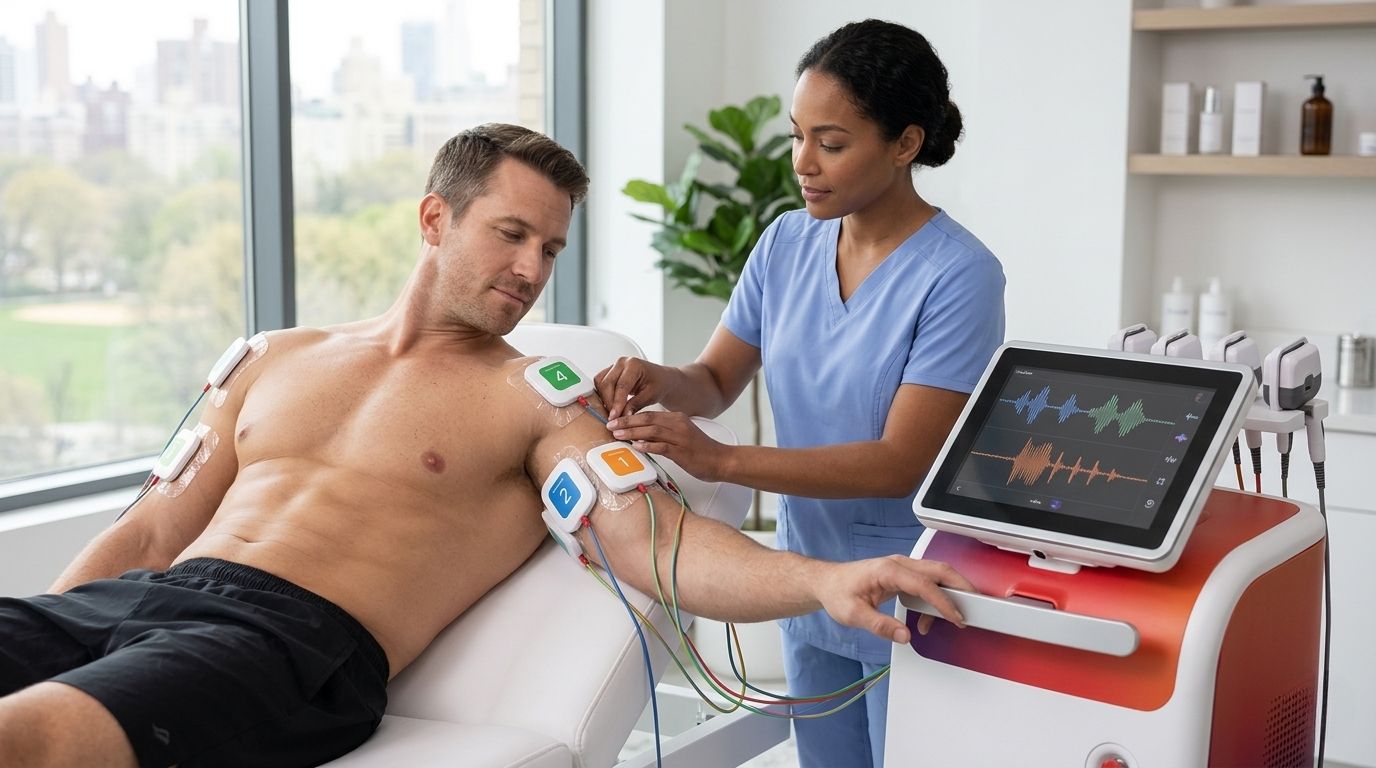
At Scottsdale Physical Therapy & Performance, this exact technology is central to how the clinic approaches muscle activation and recovery. As the Arizona flagship clinic within the Restimulate Health network, founded by Dr. Edward A. Alvarez, the practice uses the truFlex neuromuscular activation system.
The truFlex System
The truFlex device stimulates muscles using Multi-Directional Stimulation, which allows multiple muscle groups to be engaged simultaneously rather than isolating one muscle at a time. That’s a meaningfully different experience than a single-channel unit targeting one muscle in isolation.
What sets this approach apart is how it’s built into a performance-first philosophy rather than treated as an isolated modality. If you’re a post-surgical patient trying to get your quad firing again after a knee procedure, this is a tool your therapist can lean on early in your recovery.
The same holds true if you’re an older active adult working to preserve muscle strength and balance, or an athlete recovering from a soft tissue injury who wants to get back to training without losing ground. truFlex sessions are designed to fit into a larger plan built around your specific goals, not delivered as a one-size-fits-all add-on.
Who’s on Your Care Team
The clinical team includes Dr. John Dodson, who brings a TPI Level 1 certification and a focus on golfers and overhead athletes, and Grace De Haan, a personal trainer and performance coach. Together they combine neuromuscular activation with hands-on physical therapy, sports performance training, and personal training where it makes sense.
Getting a muscle to contract during a session is only half the job. What matters more is making sure that improved muscle activation translates into how you move, lift, swing, and perform once you’re back to your sport or your workout routine.
What This Looks Like in Practice
Because this clinic treats active adults and athletes rather than a general patient population, sessions tend to move quickly toward functional goals. That might mean getting your quad strong enough to squat with confidence again, restoring the muscle activation you need for a stable golf swing, or rebuilding strength lost during a period of immobilization so you can get back to CrossFit without reinjuring yourself.
If you’ve been dealing with a muscle that just won’t respond the way it used to, whether that’s after surgery, an injury, or a long stretch of inactivity, it’s worth having a real conversation about whether NMES and truFlex have a place in your recovery. Reach out to our team to set up an evaluation.
We’ll walk you through exactly what a personalized plan would look like for your specific situation, your goals, and the activities you’re working to get back to.
Frequently Asked Questions
Does NMES Hurt?
It can cause some discomfort, especially as intensity increases, since a session needs to produce a strong enough contraction to have a training effect. Most patients describe it as an intense muscle contraction rather than sharp pain.
Your physical therapist adjusts the settings to keep it tolerable while still effective. Some muscle soreness afterward, similar to post-workout soreness, is normal and usually resolves within a few days.
How Is NMES Different From a Muscle Stimulator Machine You’d Buy Online?
Clinical NMES uses adjustable frequency, pulse width, and intensity settings that get tailored to your specific muscle, condition, and stage of recovery. It’s applied by a physical therapist who has assessed exactly what’s going on with your muscle activation.
Consumer devices don’t offer that same level of customization or clinical oversight, which matters both for safety and for actually getting results. Without that oversight, it’s easy to under-dose a treatment or push it too far in the wrong direction.
How Many Sessions Before I Notice a Difference?
This varies depending on why you’re using it. Post-surgical patients working to reactivate an inhibited muscle sometimes notice improved contraction within the first few sessions.
Building meaningful strength typically takes several weeks of consistent treatment combined with active exercise. Your physical therapist will track your progress and adjust the plan as you go.
Can I Start NMES or truFlex Without a Referral?
In most cases, yes. Arizona allows direct access to physical therapy, meaning you can schedule an evaluation without a physician referral first. During that evaluation, your physical therapist will determine whether NMES or truFlex fits your specific situation and put together a plan from there.
Is NMES Only for Post-Surgical Patients, or Can Athletes Use It Too?
It’s used well beyond post-surgical recovery. Athletes use it to support muscle activation, address lingering weakness after an injury, and even assist with post-exercise recovery.
Older active adults use it to help preserve muscle strength and balance. The common thread is a muscle that isn’t activating or recovering the way it should, regardless of what caused that in the first place.