
Every stride and every box jump routes force straight through your Achilles tendon. So when an ache along the back of your heel starts showing up mid-run or during warm-up sets, it’s easy to write off as normal tightness. If it’s sticking around, you’re probably dealing with Achilles tendonitis, and the right stretches for Achilles tendonitis can make a real difference in how quickly you get back to full speed. This guide walks through a step-by-step routine built for runners and CrossFitters whose training depends on a healthy, resilient Achilles.
What’s Actually Happening in Your Achilles Tendon
Your Achilles tendon is the thick band of tissue connecting your calf muscles to your heel bone, and it’s the strongest tendon in your body. That strength comes from how much work it does, absorbing and transferring load with every stride, jump, and sprint you take.
Achilles tendonitis develops when this tendon becomes irritated and inflamed, usually from repetitive stress that outpaces its ability to recover. In runners, that often means too many miles too quickly. In CrossFitters, it’s frequently the jump rope volume, box jumps, and sprint intervals stacking up on a tendon that hasn’t had time to adapt. Tight calf muscles add to the problem too, since a stiff gastrocnemius and soleus pull directly on the tendon with every step.
Left alone, this irritation can progress into achilles tendinopathy, a more chronic breakdown of the tendon’s collagen structure. That’s why catching it early and pairing stretching with real strengthening matters so much.
Causes, Symptoms, and How It Limits Your Training
What Typically Causes It
Achilles tendonitis rarely comes from one bad workout. It’s usually the buildup of a few overlapping factors.
Sudden increases in training volume or intensity are the most common trigger, whether that’s ramping up weekly mileage too fast or adding a box jump progression without easing in. Tight calf muscles and limited ankle mobility add extra tension to the tendon with every stride. Improper footwear, especially shoes that have lost their support or don’t match your gait, shifts more load onto the tendon than it’s built to absorb.
What Symptoms Look Like
Most people notice a dull ache or stiffness along the back of the heel or lower leg, often worse first thing in the morning or right after a workout. There may be mild swelling or tenderness directly on the tendon, and the area can feel warm to the touch after activity. Pain that eases with rest but returns as soon as you pick the pace back up is a classic sign of tendon-related pain rather than just a sore muscle.
How It Shows Up in Your Training
For runners, push-off often feels weak or painful, especially on hills or during speed work. For CrossFitters, box jumps, double-unders, and sprint work are usually the first movements that start to hurt, since they demand explosive force through the tendon. Left untreated, achilles tendon pain has a way of quietly reshaping your training, and most people end up avoiding the exact movements that would help them build the strength to recover.
A Step-by-Step Achilles Tendonitis Stretching Routine

Stretching alone won’t fully resolve Achilles tendonitis, but it plays an important supporting role alongside strengthening. Every stretch below should feel like a gentle pull, never sharp pain. If something hurts, back off and try an easier version, or drop the range of motion until it feels manageable again.
Standing Calf Stretch
This targets the gastrocnemius, the larger of your two calf muscles, and it’s one of the most effective stretches for Achilles tendonitis when done consistently.
Stand facing a wall with your hands placed on it at about eye level. Step the leg you want to stretch behind you, keeping your back knee straight and your back heel pressed into the floor. Bend your front knee slightly and lean toward the wall until you feel a gentle stretch through your calf. Hold for 30 seconds, then switch legs. Repeat two to three times per side.
Soleus Stretch
The soleus sits underneath your gastrocnemius and also attaches directly to the Achilles tendon, so it’s worth stretching separately.
Start in the same standing position as the calf stretch, but this time bend your back knee slightly instead of keeping it straight. Keep your back heel on the floor as you shift your hips toward the wall. Hold for 30 seconds, then switch sides.
Toe-to-Wall Stretch
If the standing calf stretch bothers your shoulders or feels awkward to balance, this version puts less demand on your upper body while still reducing tension on the Achilles tendon.
Stand facing a wall and place the toes of your affected foot up against it, keeping your heel flat on the floor. Lean forward from your ankle until you feel a stretch along the back of your lower leg. Hold for 30 seconds, then switch feet.
Eccentric Heel Drops
Eccentric heel raises are one of the most effective tools for building tendon resilience, and they double as both a stretch and a strengthening exercise.
Stand with the balls of your feet on the edge of a stair step or curb, letting your heels hang off the back. Rise up onto your toes using both feet, then shift your weight to the affected leg and lower that heel slowly below the level of the step. The slow lowering phase is what builds real tendon strength. Do two to three sets of 10 to 15 reps, adding load only once these feel pain-free.
Resistance Band Ankle Stretch
A resistance band adds gentle tension that helps stretch and strengthen the muscles feeding into your Achilles tendon at the same time.
Sit on the floor with your affected leg extended straight in front of you. Loop a resistance band around the ball of your foot and hold both ends with your hands. Pull the band to flex your foot toward you, hold briefly, then point your foot away and repeat. Complete 10 to 15 reps, then switch sides if needed.
How Often to Do These Stretches
Most people see the best results stretching once or twice daily, ideally after a light warm-up rather than on a completely cold tendon. Consistency matters more than intensity here. A gentle daily routine will get you further than one aggressive session a week.
Red Flags That Mean It’s More Than Simple Tightness
If pain persists despite several weeks of consistent stretching and modified activity, or if you notice sharp pain, significant swelling, or a sense of weakness when pushing off, it’s time to get evaluated by a physical therapist rather than continuing to self-manage. Persistent pain that doesn’t respond to rest and stretching can be a sign the tendon needs a more structured, personalized treatment plan.
How Physical Therapy Helps Achilles Tendonitis Heal
A physical therapist brings something stretching alone can’t: a clear picture of why your Achilles tendon became irritated in the first place. That means assessing your running gait, ankle mobility, calf strength imbalances, and how your training load has changed recently.
Treatment typically combines manual therapy to reduce tension in the surrounding muscles with a progressive loading program built around your sport. Isometric holds are often introduced early to manage pain while keeping the tendon active, followed by eccentric strengthening work like heel drops, and eventually more dynamic, sport-specific loading as symptoms calm down. Strengthening exercises for the calf, ultimately, do more for long-term recovery than stretching alone, since a stronger calf takes pressure off the tendon with every step. A skilled therapist also builds in a gradual return-to-running or return-to-CrossFit plan, so you’re not jumping back into full volume before the tendon is ready.
How Scottsdale Physical Therapy & Performance Approaches Achilles Tendonitis
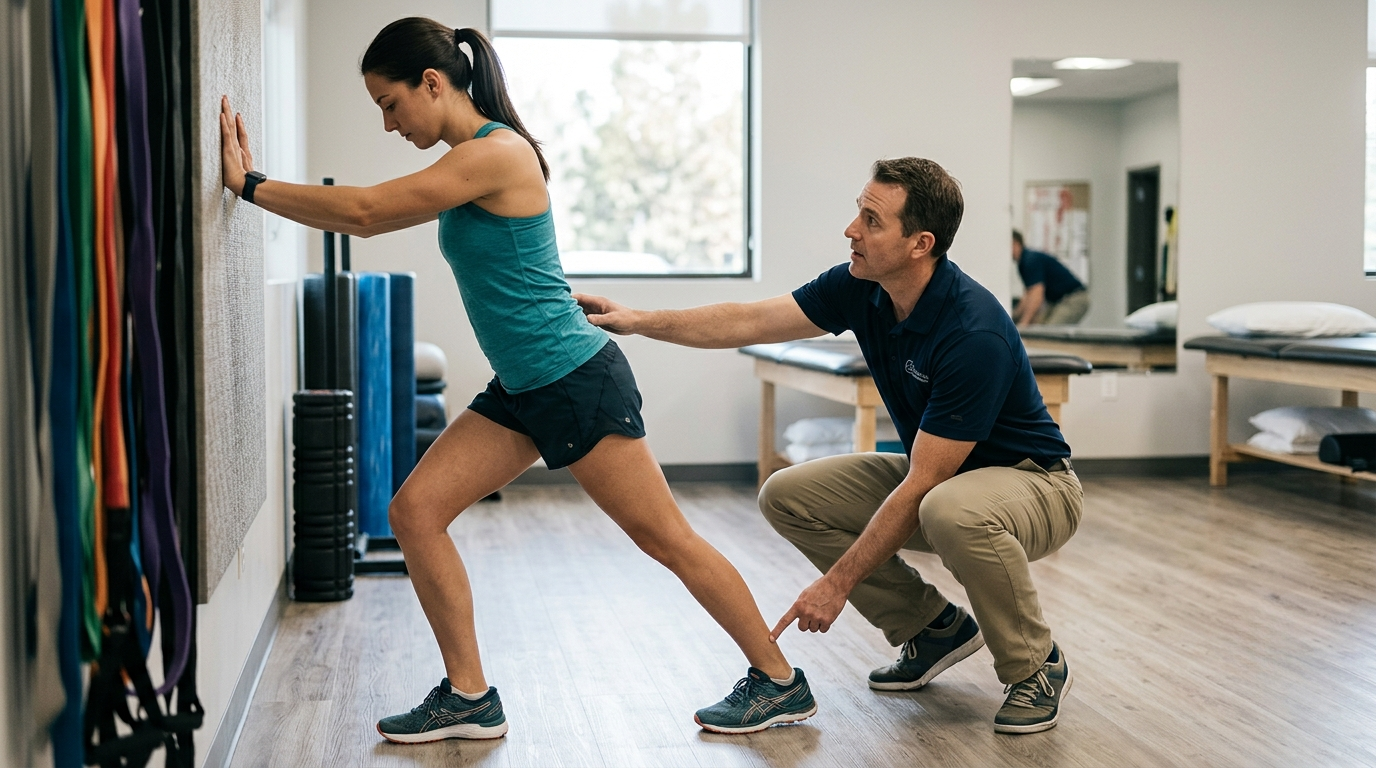
At Scottsdale Physical Therapy & Performance, treating Achilles tendonitis starts with figuring out exactly what’s driving the irritation, whether that’s training load, calf strength, ankle mobility, or footwear. Our team will build individualized plans that combine hands-on manual therapy with a structured strengthening progression, aimed at getting runners and CrossFitters back to full training, not just pain-free walking.
For tendons slow to respond to standard loading protocols, truFlex neuromuscular activation training can help retrain the calf muscles to fire more efficiently through the movements that matter most in your sport. Because return to sport is the actual goal, the clinic’s return-to-running and return-to-CrossFit programs are built to bridge the gap between rehab exercises and getting back to full mileage or workout intensity with confidence.
If you’ve been managing this on your own for weeks without real progress, that’s usually the signal it’s time for a proper evaluation.
Achilles tendonitis responds well to patience and consistent work. Stretching keeps the tendon flexible, strengthening builds the resilience it needs, and knowing when to bring in a professional keeps a manageable issue from turning into a long layoff. If you’re ready to stop guessing and start a plan built around your sport and goals, reach out to our team to schedule an evaluation.
Frequently Asked Questions
How Long Does Achilles Tendonitis Take To Heal With Stretching Alone?
Mild cases often improve within a few weeks of consistent stretching and activity modification, but stretching alone rarely resolves things completely. Pairing it with a strengthening program, especially eccentric heel drops, produces faster, more lasting results. For a fuller breakdown of typical timelines by severity, our guide to Achilles tendonitis recovery time covers that in more detail.
Can I Keep Running Or Doing CrossFit With Achilles Tendonitis?
Often yes, but with modifications. Reducing volume, avoiding high-impact movements like sprints and box jumps, and substituting lower-impact conditioning can help you stay active while the tendon heals. A physical therapist can help you figure out exactly what to scale back.
Do I Need A Referral To See A Physical Therapist For Achilles Tendonitis?
Usually not. Arizona allows direct access to physical therapy without a physician referral, so you can schedule an evaluation as soon as symptoms start interfering with your training.
Is It Normal For Achilles Tendonitis To Come Back After It Heals?
It can, especially if the underlying cause, like calf weakness or a training load spike, isn’t addressed. That’s why a good rehab plan focuses on building strength and correcting training habits, not just calming down the current flare-up.
When Should I Stop Stretching And See Someone Instead?
If pain persists longer than a couple of weeks despite consistent stretching, or if you notice swelling, sharp pain, or weakness pushing off, it’s time to have a physical therapist take a closer look rather than continuing to manage it alone.