If you’ve ever watched a teammate blow past you off the line or cut hard to the left while you’re still deciding which way to go, you already know the gap. Speed and agility training is what closes it.
Whether you’re a weekend soccer player, a golfer trying to generate more clubhead speed, or a youth athlete gearing up for a pre-season combine, the ability to move fast and change direction under control is a trainable skill, not something you either have or don’t.
A lot of Scottsdale athletes assume speed is genetics and agility is something you’re born with. That’s not accurate. Both qualities respond to the right kind of training, and both break down predictably when that training is missing or done wrong.
Once you know what’s actually happening in your body when you sprint, cut, or react, you’ve got a much better starting point than another round of random cone drills. This guide breaks down what speed and agility actually mean, what typically holds athletes back, and how to build a program that produces real results.
What Speed and Agility Really Mean
These two words get used interchangeably, but they’re not the same thing, and training them well means understanding the difference.
Speed, Acceleration, and Top-End Speed
Speed is the rate at which you’re able to move. Within that broad category are two distinct pieces: acceleration, which is how quickly you increase your speed from a stop, and top-end speed, which is your highest possible speed once you’re already moving.
Deceleration matters just as much, even though it gets far less attention. It’s your ability to slow down quickly and efficiently, and it’s what lets you plant, stop, or absorb an awkward landing without your knee or ankle paying the price.
Agility and Reactive Quickness
Agility is the ability to move quickly and easily, especially when you have to change direction. Cone drills and ladder drills build the footwork foundation, but real agility on the field or court is reactive.
You’re not running a pre-planned pattern. You’re responding to a defender, a ball, or an opponent’s movement in real time, and research on agility confirms that reactive layer is what separates a fast athlete from an agile one.
Plenty of athletes can run a great sprint in a straight line and still get beaten badly on a cut, because change of direction and reaction time are their own skills that need their own training.
What’s Actually Holding Your Speed and Agility Back
Most athletes who feel slow or clunky aren’t lacking effort. They’re missing one or two specific pieces of the puzzle.
Weak Force Production and Poor Deceleration
Getting faster comes down to how much force you can put into the ground and how efficiently you absorb it back. Athletes who haven’t built a strength foundation struggle on both ends: they can’t accelerate hard, and they can’t decelerate safely, which is often where non-contact injuries happen.
Olympic lifting variations and heavy squat or deadlift patterns build the explosive power that speed work depends on. Plyometric exercises, like depth jumps and bounding, teach the body to produce and absorb force quickly, and research on team-sport athletes shows this kind of training improves both acceleration and deceleration mechanics.
Training in Only One Direction
Straight-line speed and multi-directional agility are related, but they aren’t the same skill. An athlete who only sprints in a straight line often struggles the moment a defender or an uneven surface forces a lateral shuffle or a hard plant-and-cut.
Dynamic trunk control ties directly into this. Research on core stability shows that without a strong, stable core, force generated in the hips and legs leaks out before it translates into a clean sprint or a controlled cut.
That’s one reason core strength work belongs in almost every well-built speed and agility program, alongside the sprint work and drills athletes tend to focus on first.
How Slow Speed and Poor Agility Show Up in Your Sport
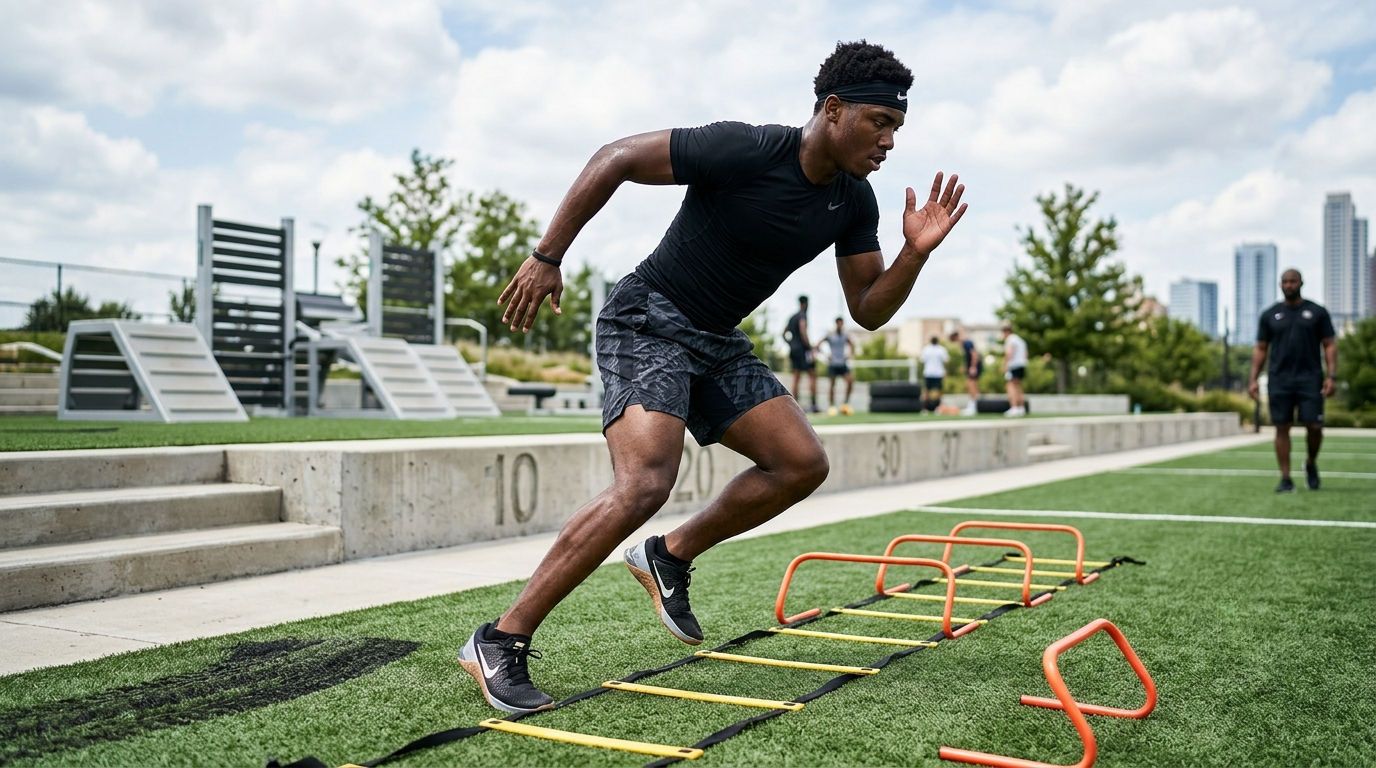
These limitations rarely stay hidden. They show up in specific, frustrating ways depending on your sport.
On the Field, Court, or Course
Runners feel it as a flat, inefficient stride and a slower kick in the final stretch. Field-sport athletes, whether it’s soccer, flag football, or basketball, feel it as getting beaten to a spot or hesitating before reacting to the play.
Golfers may not think of agility as part of their game, but hip rotation, single-leg stability, and reactive body control feed directly into how much clubhead speed they generate and how consistently they repeat their swing.
CrossFitters and gym-goers notice it differently, usually as sloppy footwork during box jumps or agility-based workouts, or a sense that their movements look labored compared to more explosive athletes in their class.
In the Gym and Everyday Movement
Even outside of organized sport, weak agility and poor reaction time show up in everyday life. Catching yourself after a stumble, reacting to a pet darting across your path, or simply moving through a crowded space all rely on the same coordination and body control that speed and agility training builds.
Older active adults in particular benefit here. Clinical guidance on fall prevention points to improved coordination and balance as key factors in reducing fall risk, and that carryover matters just as much as anything happening on a field or a track.
Building a Speed and Agility Program That Works
A program that actually improves speed and agility needs structure, not just a rotating list of drills pulled from a sports performance training plan built for someone else. Here’s what belongs in it.
Warm Up and Movement Prep
Every session should start with a real warm up, not a jog and a few stretches. Marching drills, skips, and short accelerations raise body temperature, wake up the nervous system, and prepare the muscles for the maximal effort work coming later in the session.
Skipping this step costs more than most athletes realize. Speed and agility work is neurologically demanding, so heading into it without a proper warm up means asking your body to hit top speed or react instantly before it’s ready.
Linear Speed and Acceleration Work
Sprinting is still the best way to improve top-end speed, and it needs to be done at close to full effort to drive real adaptation. Short accelerations build the ability to get up to speed quickly, while longer sprints work on maintaining that speed once you’ve reached it.
Resisted sprints, using a sled or a band, add an extra layer of force production without changing the sprint’s mechanics.
Lateral Movement and Change of Direction
Shuffling, crossover steps, and cone-based cutting drills train the body to decelerate, change the level of the hips, and reaccelerate in a new direction. This is where a lot of field-sport and court-sport performance actually lives.
Ladder drills have a place here too, mainly as a coordination and footwork tool early in a session, before fatigue starts to affect quality.
Reactive Drills and Rest Intervals
Reactive agility work adds a decision-making layer on top of the physical one, using a coach’s call, a color, or a partner’s movement as the trigger to change direction. This most closely mirrors what actually happens in a game.
Rest matters as much as the work itself here. Without full recovery between reps, quality drops fast and the intended adaptation doesn’t happen.
As a general guide, athletes need roughly 10 to 12 seconds of rest for every second of maximal output. Training while fatigued undermines the point of the session, since once form breaks down, the drill stops building speed and starts building bad habits.
How Physical Therapy Improves Your Speed and Agility
A physical therapy evaluation does more for a speed and agility program than most athletes expect. Rather than jumping straight into drills, a thorough assessment looks at joint mobility, single-leg stability, and movement patterns to find what’s actually limiting faster, cleaner movement.
That matters because pushing hard into sprint work without addressing an underlying restriction, whether it’s limited hip rotation, a strength asymmetry between legs, or poor ankle mobility, tends to reinforce compensations rather than fix them.
A physical therapist identifies those issues early and builds a plan that trains around them safely while still working toward real performance gains. This is also where injury prevention and performance training overlap.
Recent research on neuromuscular training shows this kind of training reduces injury risk when it’s built on a stable foundation, and a PT evaluation is what confirms that foundation is actually there before loading up the intensity.
How Scottsdale Physical Therapy & Performance Approaches Speed and Agility Training
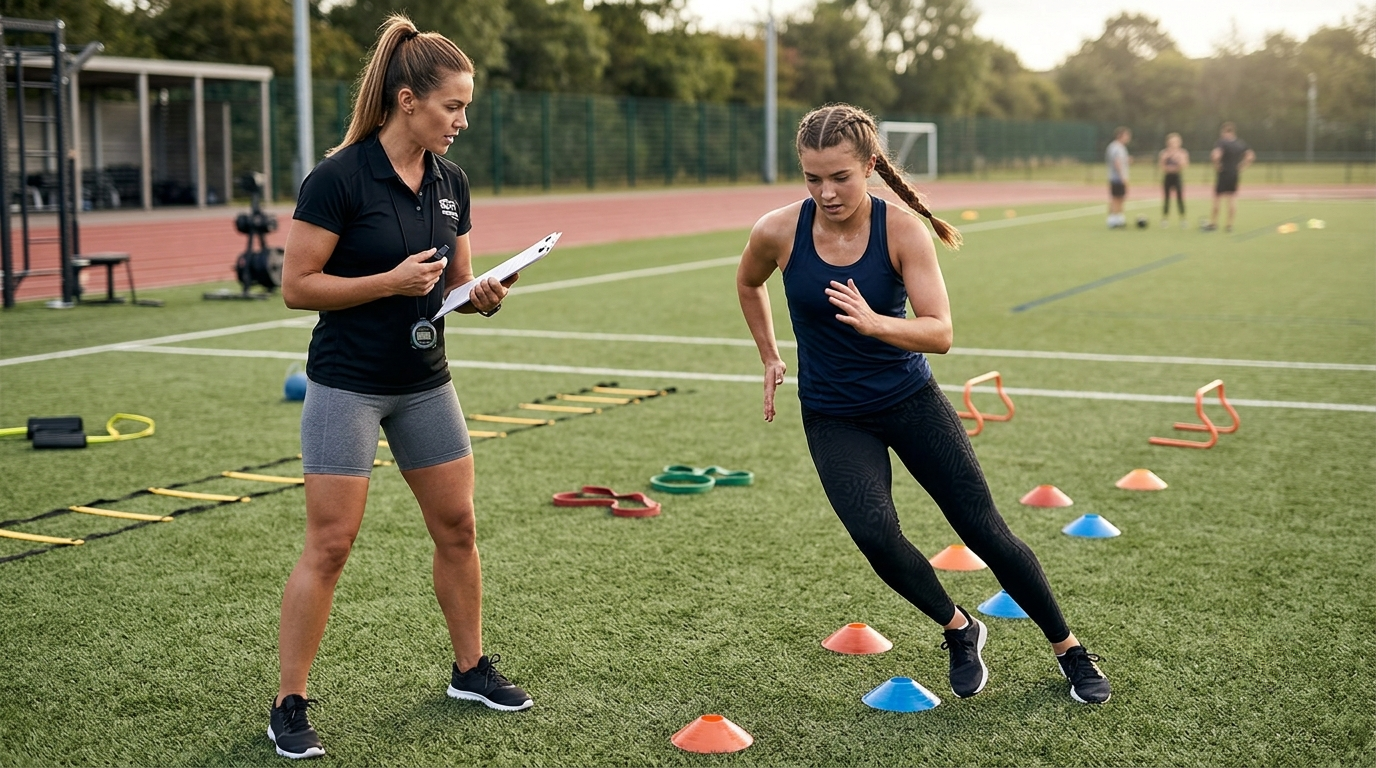
At Scottsdale Physical Therapy & Performance, speed and agility programming starts with an individualized assessment rather than a generic drill list. Grace De Haan, our Personal Trainer and Performance Coach, builds personal training programs around each athlete’s sport, ability level, and specific movement limitations, whether that’s a youth athlete prepping for tryouts or a weekend warrior keeping up in a competitive league.
Our truFlex neuromuscular activation training fits naturally into this kind of work, since it’s designed to sharpen the connection between the nervous system and the muscles responsible for quick, explosive movement. For athletes whose reaction time or force production is being limited by inefficient neuromuscular firing rather than a lack of effort, that extra layer of activation work can make a real difference.
When pain, a previous injury, or a movement restriction is part of the picture, Dr. John Dodson brings that clinical piece into the plan, treating the underlying issue directly rather than training around it.
Whether you’re chasing a faster time, a quicker first step, or more confidence in how you move, a plan built around your specific movement patterns beats a one-size-fits-all program. Reach out to our team to set up an evaluation and find out what’s standing between you and the speed and agility you’re after.
Frequently Asked Questions
How Long Does It Take To See Results From Speed And Agility Training?
Most athletes notice improved coordination and confidence within a few weeks, while measurable gains in top-end speed and change of direction typically take six to eight weeks of consistent training.
Can Beginners Do Speed And Agility Training, Or Is It Only For Competitive Athletes?
Beginners benefit too, often more noticeably than advanced athletes, since foundational coordination, balance, and body control tend to improve quickly with focused work.
How Often Should I Train Speed And Agility Each Week?
Two to three focused sessions per week is typically enough to drive adaptation without overloading the nervous system, especially alongside sport practice or strength training.
Do I Need A Referral To Start A Speed And Agility Program At Scottsdale PT?
No referral is required. You can schedule directly with our team for an evaluation and a program built around your specific goals.