Athletes who stay competitive through their 40s and 50s share one habit: they train the body their sport actually demands. Athletic conditioning training, when structured around the mechanics of a golf swing or a running stride, produces measurable, lasting performance gains that generic cardio and gym sessions simply do not replicate. The TPI-certified physical therapists at Scottsdale Physical Therapy & Performance build sport-specific conditioning programs grounded in clinical assessment and current research. This guide walks through workouts, methods, and evidence that can change how you perform on the course and on the road.
What Is Athletic Conditioning Training?
Athletic conditioning training is a structured, progressive program that builds the physical attributes athletes need for their sport, including muscle strength, cardiovascular endurance, core stability, bone density, and efficient energy systems. It avoids chasing generic health markers and instead targets output that matters for a specific sport. A 2020 systematic review published in the Journal of Sports Sciences analyzed 25 studies and confirmed that strength and conditioning interventions produced average performance gains of 4 to 6.4% in sport-specific metrics including clubhead speed and ball speed (Ehlert, 2020).
Think of it this way: your body acts as the equipment. A golfer who obsesses over the latest driver while ignoring weak hips and a stiff thoracic spine is like someone buying premium tires for a car with a worn-out engine. Performance depends on the condition of the machine that drives the club, not the club alone. Athletic conditioning training tunes that machine for the movements, speeds, and loads your sport places on it, instead of the generic demands that simply keep an annual physical looking acceptable.
Conditioning Training vs. General Fitness
General fitness improves overall health. Athletic conditioning builds the specific capacity a sport demands. A golfer needs explosive rotational force through the hips, and a runner needs metabolic and neuromuscular endurance to maintain stride efficiency over extended periods. Training hard without matching those demands means working without a clear adaptation goal.
Put simply, walking 10,000 steps a day is great for your health. That habit does very little for clubhead speed or a 5K pace. General fitness forms the floor. Athletic conditioning builds the structure above that base. When a TPI-certified PT reviews a program, the key question is less “Are you active?” and more “Are you training what your sport truly requires?”
How Strength Training Changes the Athlete’s Body Over Time
Progressive overload, the gradual increase in stress applied to muscle tissue through load, volume, or density, drives the physiological changes that make athletes more resilient and more powerful. Resistance training rebuilds muscle tissue at the cellular level, raises bone density, and improves the tensile strength of connective tissue. The National Strength and Conditioning Association (NSCA) lists progressive overload as a core principle of evidence-based resistance training programs, with measurable changes appearing across 8 to 12 weeks of consistent training (NSCA, 2017).
Your muscles, bones, and tendons are living tissue. When you stress them just past what they are used to, they rebuild slightly stronger to handle that load next time. Repeat that process week after week, and what was once heavy becomes manageable, what was once fast becomes controlled. Picture a callus forming on your hand from gripping a club. That is your body adapting to a repeated demand. Progressive overload does the same thing to your entire musculoskeletal system, just with intention and structure behind it instead of chance.
Conditioning Workouts for Golfers: More Distance, Better Control
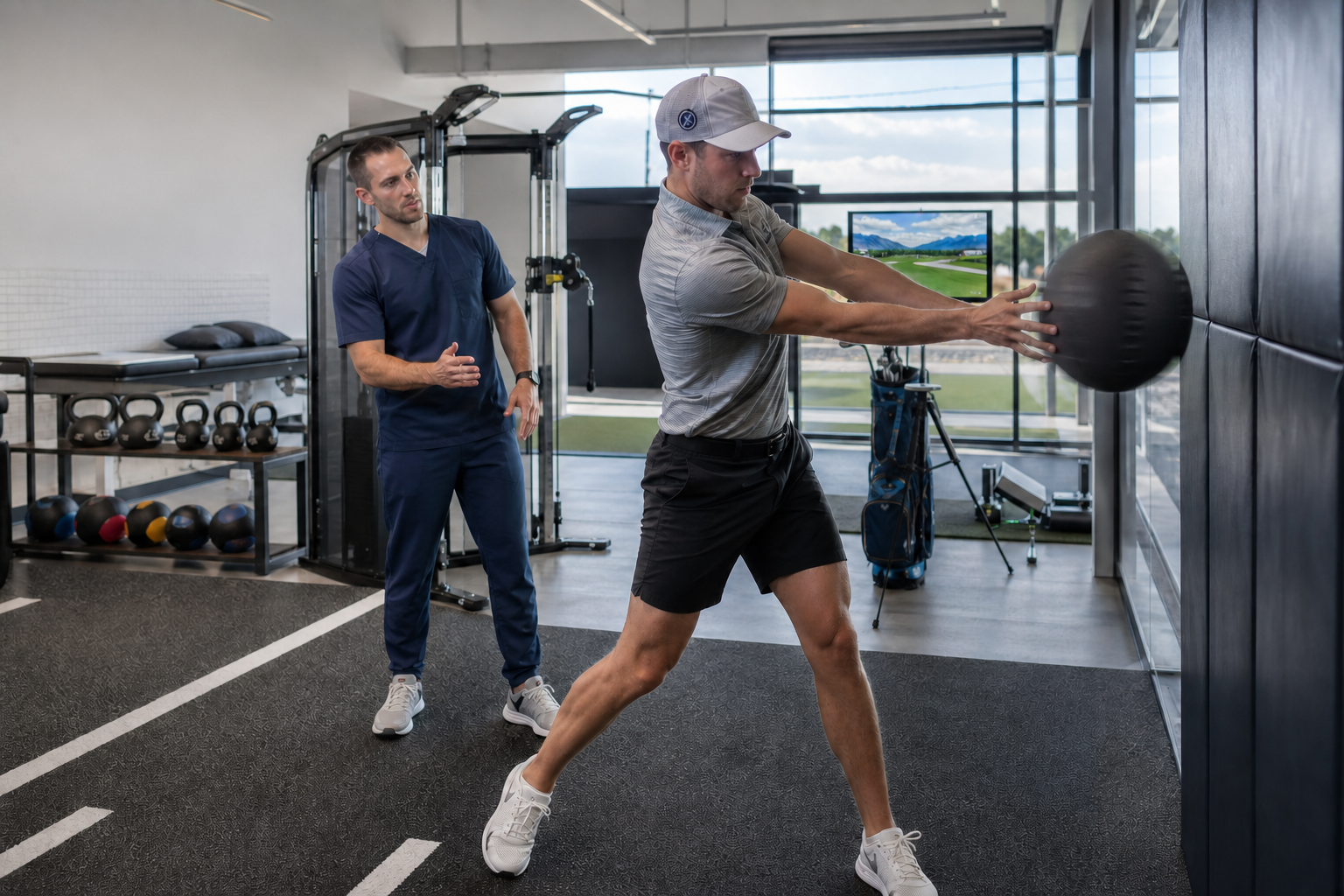
A 2026 study published in the Journal of Strength and Conditioning Research tracked university-level golfers through a 10-week program: six weeks of strength training followed by four weeks of power training, each phase run twice per week. Male golfers showed large improvements in carry distance and ball speed. Female golfers demonstrated statistically significant, large improvements across all isometric bench press metrics and carry distance. The researchers concluded that large improvements in golf shot data can be produced from strength and power training twice a week for just 10 weeks, with maximal and rapid upper-body force production identified as especially critical for female golfers (Bishop et al., 2026).
Ten weeks of training, twice per week, is a surprisingly modest commitment for the performance gains it delivers. The personal training team at Scottsdale PT & Performance builds sport-specific conditioning programs that account for each golfer’s movement screen results, current fitness baseline, and performance goals, then tracks measurable change using VALD human measurement technology so progress is never a guessing game.
Medicine Ball and Power Training for Club Head Speed
Medicine ball rotational throws are a staple in any serious physical training program for golfers, and the reason is mechanical precision. The movement trains the transverse plane pattern that mirrors the golf swing’s kinetic chain from the ground up. Standing at shoulder width, the athlete loads through the hip, fires through the core, and releases through the shoulder blades, producing the same sequence a full-speed swing demands. Rotational power training programmed at low volume with maximal intent produces direct, measurable improvements in clubhead speed, which is one of the most trackable markers of overall athletic performance on the course (Bishop et al., 2026).
For elite athletes, this movement is a conditioning workout staple. Recreational golfers get the same return when the movement is coached correctly and executed with intent over a consistent training routine.
Box Jumps and Lateral Bounds for Lower-Body Power
Ground reaction force is trainable, and that is what makes box jumps and lateral bounds a legitimate part of any sports performance program for golfers. The body’s ability to push forcefully into the ground and receive that force back upward through the kinetic chain determines how much speed reaches the club at impact. Box jumps and lateral bounds develop the explosive lower-body output that drives that force production, and both belong in a workout routine built around improving athletic performance from the ground up.
Recreational golfers respond well to 3 sets of 5 to 8 box jumps at controlled intensity, with full recovery between sets, before adding lateral bounds as a second movement in the same session. Progressing too quickly without adequate recovery undermines the adaptation that makes these conditioning exercises effective.
Core Stability Work That Actually Transfers to the Course
Core stability for golfers has nothing to do with crunches. It is entirely about the body’s ability to resist unwanted rotation while producing intentional rotation through the hips, and that distinction separates a training program that actually improves athletic performance from one that just looks productive. The pallof press, dead bug, and single-leg Romanian deadlift train anti-rotation under load, which is exactly what the lumbar spine must manage during a full-speed swing. TPI’s physical screen directly correlates core stability deficits to the most common swing faults, including reverse spine angle and loss of posture (Titleist Performance Institute, n.d.).
Golfers who stay consistent with this type of physical training across an 8 to 12-week conditioning program report fewer swing breakdowns under fatigue, which tracks with what the research shows about strength and conditioning improving late-round performance in all the benefits categories that matter: distance, accuracy, and physical resilience.
Conditioning Training for Runners: Speed, Stamina, and Staying Injury-Free
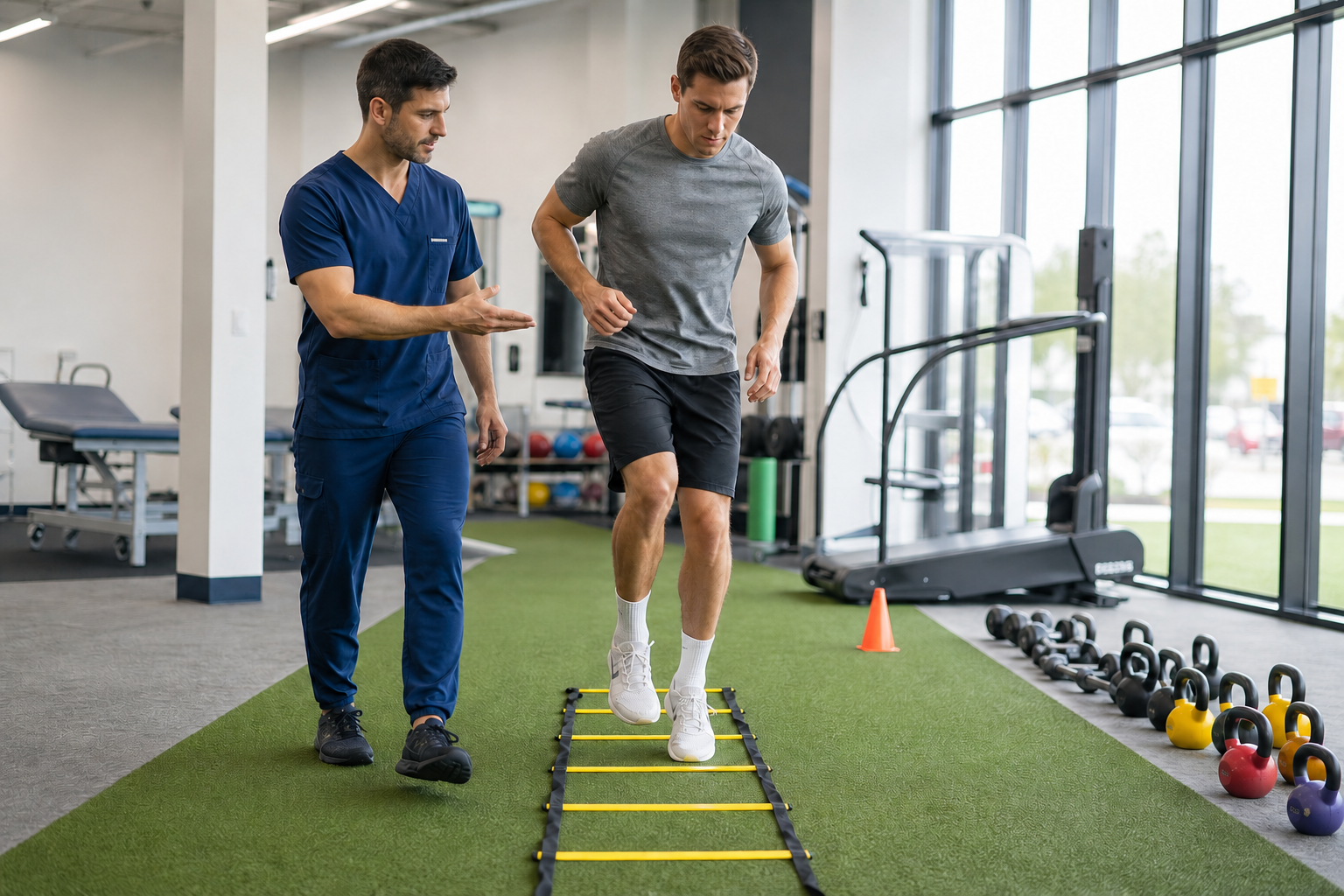
Running carries a deceptively high physical cost. A systematic review and meta-analysis published in Sports Medicine analyzed 1,904 endurance runners across nine randomized controlled trials and found that injury incidence and prevalence in this population exceed 40% (Wu et al., 2024). The tissues most frequently affected are the patellofemoral joint, medial tibia, and Achilles tendon, and the common denominator across most of these injuries is repetitive compressive load applied to tissues that lack the strength to absorb it across extended periods. Road runners carry this load on predictable terrain. Trail runners add lateral demands, uneven surface stabilization, and hip loading that road training never replicates.
What the Wu et al. (2024) review also confirmed is that supervision matters significantly. Pooled data from unsupervised programs showed no statistically significant reduction in injury risk. When supervision was present, injury risk dropped significantly in favor of the conditioning group. That finding has a direct clinical implication: a running conditioning program built and monitored by a qualified clinician outperforms the same program done independently. The physical therapy team at Scottsdale PT & Performance begins every runner’s program with a root-cause evaluation before any loaded conditioning starts, which is precisely the supervised, individualized model the evidence supports.
Ladder Drills and Agility Drills That Improve Running Economy
Running economy measures how much oxygen the body uses to sustain a given pace. Athletes with higher running economy burn less energy per stride, which means they run faster for longer before fatigue compromises their form. Ladder drills and agility drills train the neuromuscular coordination, foot strike timing, and stride cadence that determine that economy. When the nervous system learns to fire muscles more efficiently through repetitive speed and coordination work, the oxygen cost per stride drops, and the athlete gets more output from the same physiological effort.
Prospective research has identified weak hip stabilizers and delayed neuromuscular recruitment as biomechanical risk factors for patellofemoral pain, medial tibial stress syndrome, and Achilles tendinopathy in runners (Wu et al., 2024). Agility-based conditioning addresses those deficits directly by training the athlete to control limb position and ground contact under speed, which is the exact demand running places on those structures at every stride. At Scottsdale PT & Performance, agility and ladder drill work is introduced after the foundational strength phase confirms that the hip stabilizers and single-leg mechanics are ready to handle speed-based loading.
Circuit Training and High-Intensity Bursts for Endurance Athletes
Circuit training strings together conditioning exercises with minimal rest, replicating the metabolic demands a runner faces mid-race when fatigue builds and form starts to slip. High-intensity bursts, structured as short intervals of maximal or near-maximal effort followed by active recovery, train the anaerobic threshold and improve the body’s ability to clear lactate and sustain pace in the final miles. A 2024 study on middle-distance runners confirmed that 10 weeks of concurrent training, which combined cardiovascular and strength work within the same program, significantly improved both cardiorespiratory endurance and speed compared to a running-only control group (Boateng et al., 2024).
A practical circuit built for endurance athletes moves through jump rope for 60 seconds, push ups for 12 reps, lateral bounds for 10 reps each side, box jumps for 6 reps, and pull ups for 8 reps, repeated for 3 to 4 rounds with 90 seconds of recovery between rounds. The sequencing matters: lower-body explosive work follows upper-body pushing, which follows cardiovascular work, so no single system reaches complete failure before the next movement is loaded. Scottsdale PT & Performance programs circuit training within the conditioning phase after each runner’s tissue resilience and movement quality have been confirmed through assessment.
Progressive Overload and Full Body Conditioning for Runners
A 12-week randomized trial conducted with first-time New York City Marathon runners found that 48.5% of participants sustained minor injuries during training, with overuse injuries accounting for the majority of withdrawals (Toresdahl et al., 2020). The researchers noted that inadequate strength and neuromuscular control of the core and hip stabilizers are established biomechanical risk factors for overuse injury in this population, and that a functional strength assessment may identify runners who would benefit most from a structured conditioning program before high-mileage training begins.
Body weight conditioning is the correct starting point for athletes who lack that foundation. Push ups, pull ups, single-leg squats, and lateral lunges build the muscular base required before adding heavy weight to any movement pattern. Once the athlete moves well under body weight, progressive overload is introduced: load increases gradually across weeks, volume adjusts to the training cycle, and intensity is managed around long-run days. Full body sessions suit runners training four to five days per week because they distribute muscular stress across the entire body, which avoids leaving key muscle groups depleted on days that demand high mileage. Staying consistent across at least 8 to 10 weeks is what allows the adaptation cycle to complete, and that consistency is far more achievable when the program is supervised and adjusted by a clinician who can read how the athlete’s body is responding.
What the Research Actually Says About Conditioning and Athletic Performance
Research on athletic conditioning training has expanded steadily over the past 15 years. A 2011 systematic review in the Journal of Sports Science evaluated 13 studies and showed that structured conditioning programs improved golf-related fitness and performance metrics, including clubhead speed, in several groups of golfers (Cann et al., 2011). A 2020 systematic review extended that work to 25 studies and reported average performance gains of 4 to 6.4% in sport-specific metrics with clinically meaningful effect sizes across recreational and competitive golfers (Ehlert, 2020). These reviews confirm that conditioning programs produce real, measurable results. More recent studies refine how much improvement athletes can expect, which athletes benefit most, and which program designs matter for long-term sports performance and health benefits.
A 2024 systematic review and meta-analysis published in the Journal of Human Kinetics analyzed 35 studies involving 777 elite athletes and found that resistance training produced a large, statistically significant overall effect on sport-specific performance across multiple sports (standardized mean difference = 1.16, 95% CI: 0.65, 1.66, p < 0.00001). Most athletes in that review improved measurably regardless of whether their program used heavy weight training or moderate loading, because the defining variable was program structure, not absolute load. Female athletes showed even larger effect sizes than their male counterparts, which mirrors what Bishop et al. (2026) found in their golf-specific intervention, where female golfers demonstrated statistically significant large improvements across all force production metrics and carry distance (Makaruk et al., 2024). Lifting weights within a periodized, sport-specific plan consistently outperformed general or unstructured physical training across every population studied.
For runners, a 2024 systematic review and meta-analysis published in Sports Medicine reviewed nine randomized controlled trials involving 1,904 endurance runners and confirmed that supervised conditioning programs significantly reduced injury incidence compared to unsupervised controls. Injury prevention is where the functional fitness argument becomes undeniable: most athletes who sustain overuse injuries do so because their tissues were never conditioned to handle repetitive loading across regular workouts. Aerobic conditioning alone does not address that gap. Functional movements, including hip flexor strengthening, single-leg stability work, and controlled loaded carries, build the tissue resilience that keeps athletes training consistently through a full season (Wu et al., 2024). The same analysis found no statistically significant protection when programs were run without clinical supervision, reinforcing the value of working with a certified strength and conditioning specialist rather than following a generic plan.
Taken together, these studies build a clear picture: conditioning training works, the effect sizes are large, and supervision from a credentialed clinician meaningfully improves both outcomes and injury prevention. The NSCA governs professional standards for conditioning coaches across the United States and requires that program design follow evidence-based periodization, progressive overload, and individual needs analysis. The Certified Strength and Conditioning Specialist (CSCS) credential, administered by the NSCA, is the recognized standard for practitioners who design and run conditioning programs for athletes at any level (NSCA, 2017).
How a TPI-Certified PT Structures a Conditioning Program
Every conditioning program at Scottsdale PT & Performance moves through four phases. The assessment phase uses the TPI Body-Swing Connection™ screen for golfers and a full-body musculoskeletal evaluation for runners, paired with VALD force plate data to establish objective performance baselines before one exercise or one rep of loaded work is prescribed. The foundation phase builds core stability, functional movements, and body weight strength, with specific attention to hip flexors, shoulder stabilizers, and single-leg mechanics — the structures most athletes have undertrained going into their first exercise session in a new program. The loading phase introduces weight training with progressive overload applied across four to six weeks, allowing muscle tissue, bone density, and connective tissue to adapt before intensity increases. Athletes slowly lower the risk of overuse injury during this phase precisely because load is introduced at a rate the tissues can manage.
The power phase converts those strength gains into sport-specific output through plyometrics, medicine ball work, rotational throws, and short bursts of speed-based conditioning, which is exactly the sequence Bishop et al. (2026) used in their 10-week intervention to produce large improvements in carry distance and ball speed. Lifting weights in the strength phase and then converting that strength into short bursts of explosive output in the power phase is the clinical sequence the research supports, and it is what separates a program built for peak performance from one built for general fitness.
The periodization model behind that four-phase sequence is not arbitrary. Research published in the International Journal of Sports Physiology and Performance confirms that integrated periodization, which coordinates strength, power, and recovery phases within a single training cycle, produces superior performance outcomes compared to non-periodized programs by managing cumulative fatigue while maintaining progressive adaptation across each phase (Kiely, 2018). At Scottsdale PT & Performance, VALD measurement data allows the clinical team to track force production, jump height, and movement quality at each phase transition, so program progressions are grounded in objective output rather than assumption.
References:
Bishop, C., Muir, I., Gartshore, A., Scott, D., Coughlan, D., Turner, A., & Murray, A. (2026). The effects of a 10-week strength and conditioning intervention on physical capacity and golf shot performance in university male and female golfers. Journal of Strength and Conditioning Research, 40(1), e32–e40. https://doi.org/10.1519/JSC.0000000000005274
Boateng, E. O., Ababio, A., Ofori, E., Quansah, K., & Amenku, A. D. (2024). Effect of concurrent training on selected physical fitness components of middle distance runners. International Journal of Sports Science and Physical Education, 9(3). https://doi.org/10.11648/j.ijsspe.20240903.12
Cann, M. A., Worsfold, P., & Bogdanis, G. C. (2011). A systematic review of strength and conditioning programmes designed to improve fitness characteristics in golfers. Journal of Sports Science, 29(9), 933–943. https://doi.org/10.1080/02640414.2011.571273
Ehlert, A. (2020). The effects of strength and conditioning interventions on golf performance: A systematic review. Journal of Sports Science. https://doi.org/10.1080/02640414.2020.1796470
Kiely, J. (2018). Periodization paradigms in the 21st century: Evidence-led or tradition-driven? International Journal of Sports Physiology and Performance, 13(5), 538–561. https://doi.org/10.1123/ijspp.2018-0093
Makaruk, H., Starzak, M., Tarkowski, P., Sadowski, J., & Winchester, J. (2024). The effects of resistance training on sport-specific performance of elite athletes: A systematic review with meta-analysis. Journal of Human Kinetics, 91(Spec. Issue), 135–155. https://doi.org/10.5114/jhk/185877
Meira, E. P., & Brumitt, J. (2010). Minimizing injuries and enhancing performance in golf through training programs. Sports Health, 2(4), 337–344. https://doi.org/10.1177/1941738110365129
National Strength and Conditioning Association. (2017). Strength and conditioning professional standards and guidelines. https://www.nsca.com/globalassets/education/nsca_strength_and_conditioning_professional_standards_and_guidelines.pdf
Oranchuk, D. J., Mannerberg, J. M., Robinson, T. L., & Nelson, M. C. (2020). Eight weeks of strength and power training improves club head speed in collegiate golfers. Journal of Strength and Conditioning Research, 34(8), 2205–2213. https://doi.org/10.1519/JSC.0000000000002505
Shaw, J., Gould, Z. I., Oliver, J. L., & Lloyd, R. S. (2024). Twelve weeks of progressive resistance training positively improves physical fitness and golf swing performance in talented youth golfers. Journal of Strength and Conditioning Research, 38(6), 1103–1110. https://doi.org/10.1519/JSC.0000000000004753
Titleist Performance Institute. (n.d.). TPI Certified Level 1. https://www.mytpi.com/certification
Toresdahl, B. G., McElheny, K., Metzl, J., Ammerman, B., Chang, B., & Kinderknecht, J. (2020). A randomized study of a strength training program to prevent injuries in runners of the New York City Marathon. Sports Health, 12(1), 74–79. https://doi.org/10.1177/1941738119877180
Wu, H., Brooke-Wavell, K., Fong, D. T. P., Paquette, M. R., & Blagrove, R. C. (2024). Do exercise-based prevention programs reduce injury in endurance runners? A systematic review and meta-analysis. Sports Medicine, 54(5), 1249–1267. https://doi.org/10.1007/s40279-024-01993-7
Frequently Asked Questions
What is athletic conditioning training?
Athletic conditioning training is a structured, progressive program that builds muscle strength, cardiovascular endurance, core stability, and efficient energy systems specific to a sport. It targets sport output, not general health markers.
Does strength training actually improve athletic performance?
A 2024 systematic review in the Journal of Human Kinetics analyzed 35 studies involving 777 elite athletes and found that resistance training produced a large, statistically significant effect on sport-specific performance across multiple sports, with a standardized mean difference of 1.16 (Makaruk et al., 2024). The effect holds across recreational and competitive populations alike.
When should a golfer or runner see a TPI-certified PT?
See a TPI-certified physical therapist when performance has plateaued despite regular workouts, or when recurring pain appears during or after sport. Scottsdale PT & Performance starts with a full-body musculoskeletal assessment to identify the root cause before any conditioning program begins.
Is conditioning training safe for recreational athletes?
Research across junior, university-level, and masters-age golfers confirms meaningful performance gains from twice-weekly programs at controlled loads (Shaw et al., 2024; Bishop et al., 2026). The starting point is a proper assessment, not a specific fitness level.