If your hips feel locked up when you get out of the car, stall halfway through a squat, or ache after a long day at a desk, you’re dealing with one of the most common movement problems we see at Scottsdale Physical Therapy & Performance. Hip mobility exercises are the fastest, most reliable way to fix it, and you don’t need to be an athlete to benefit. Desk workers, weightlifters, weekend hikers, and anyone who’s noticed their hips just don’t move the way they used to can all use the same routine to open things back up.
Your hips are the engine room for almost everything your body does, and when they lose range of motion, the joints above and below start picking up the slack, which is usually when back and knee pain shows up. Hip stiffness responds well to consistent, targeted work, and most people notice real change within a few weeks. Here’s what’s actually happening in your hips when they get tight, why it matters beyond just feeling stiff, and the complete routine to fix it.
What Hip Mobility Actually Means
Hip mobility is your hip joint’s ability to move freely through its full range without pain or restriction. The hip is a ball-and-socket joint, which means it’s built to move in several directions at once rather than just back and forth like a hinge.
Hip mobility involves flexion, extension, abduction, and rotation. Flexion and extension bring your leg forward and back, abduction and adduction move your leg out to the side and across your body, and rotation turns your thigh in and out. When all of those motions work the way they should, everyday tasks like squatting to pick something up, climbing stairs, or getting in and out of a car feel effortless.
The muscles doing most of the work here are your hip flexors and glutes, along with support from your adductors, abductors, and hamstrings. If any of these muscles get short or weak, the joint itself loses range even though nothing is technically wrong with the bones or cartilage. That’s actually good news, because it means most hip stiffness is fixable with the right exercises rather than something you’re stuck with.
Common signs of poor hip mobility include stiffness during movement, a squat that feels shallow or crooked, and a stride that’s gotten noticeably shorter. If any of that sounds familiar, you’re not imagining it, and you’re far from alone.
Why Tight Hips Cause Problems Everywhere Else
What Causes Hip Stiffness
Most hip tightness builds up slowly rather than showing up overnight. Sitting for long stretches shortens the hip flexors and tilts the pelvis forward, which changes the way you walk even before it starts to hurt. Over months and years, that adds up to real restriction, and it’s often the reason people end up dealing with hip pain long after the stiffness itself first showed up.
Weak glutes and a weak core play a role too. The gluteus maximus is particularly prone to weakness and inhibition, and when it isn’t doing its job, your hip flexors end up compensating to stabilize your pelvis. Muscles that overwork tend to tighten up as a protective response, which is especially common in people who train hard but skip mobility work entirely.
Repetitive movement patterns can also narrow your range over time. Running, cycling, and lifting all tend to groove the same limited paths through the hip joint. Without something to challenge the edges of your range regularly, those edges slowly shrink, even in people who are otherwise very active.
How Tight Hips Show Up as Movement Limitations
Tight hips rarely stay quiet. Limited hip mobility can restrict range of motion in other joints, which is why so many people with cranky knees or a stiff lower back are surprised to learn the real problem starts higher up. Restricted hip flexors are linked to increased compensatory lumbar spine movement, which is a big part of why tight hips so often show up as lower back and knee pain instead of hip pain itself.
You’ll usually notice it first in specific movements. Squats and lunges can feel pinchy or unstable. Your stride might shorten when you walk or run, since your hip can’t extend fully behind you. Getting up from a low chair or off the floor might take a little extra effort, or a small wince, that wasn’t there a few years ago.
Athletes tend to feel it in their sport specifically. A golfer with tight hips loses rotational power in the swing. A runner loses stride length and efficiency. A weightlifter loses depth in the squat and stability under a bar. Whatever your activity, hip mobility is usually somewhere near the root of it when things stop feeling as smooth as they used to.
A Step-by-Step Hip Mobility Routine
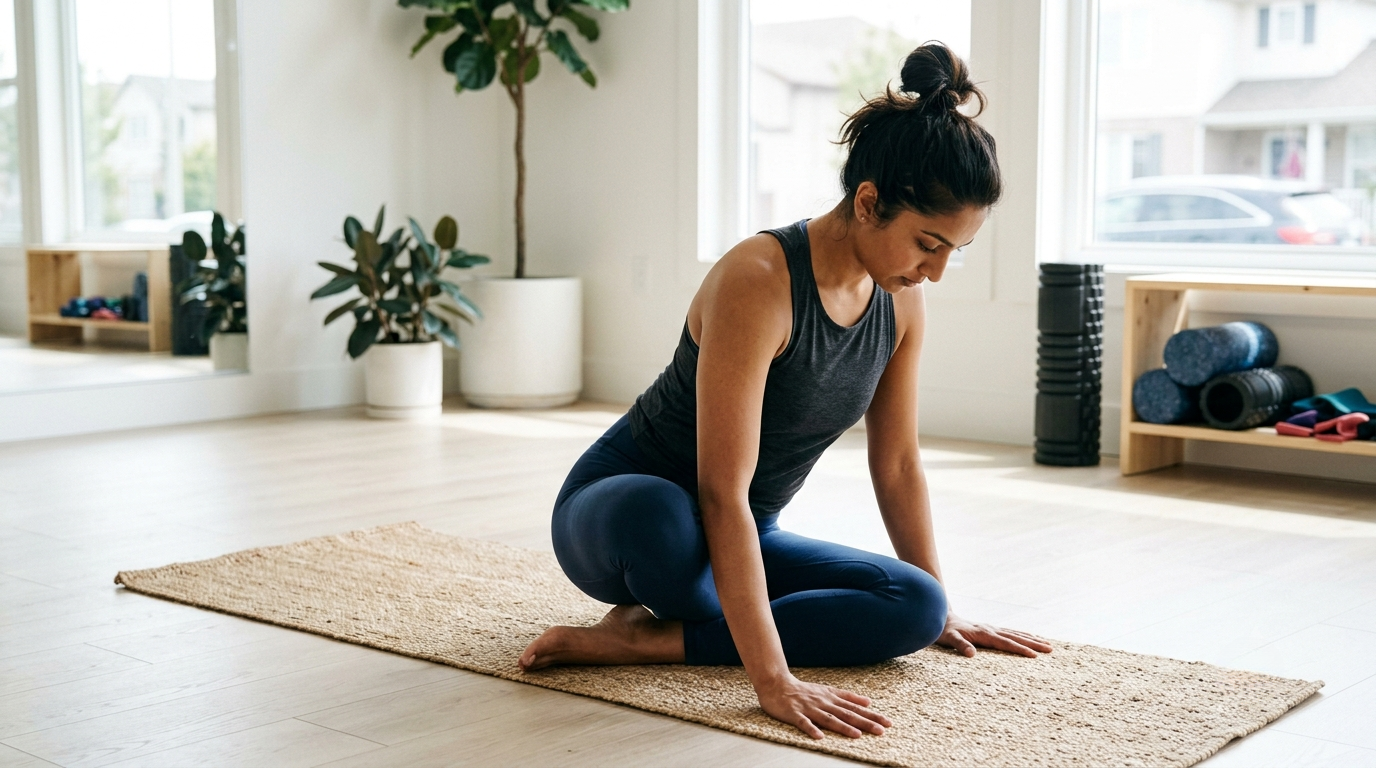
This routine is built for anyone, regardless of activity level or sport. Go through it in order, moving slowly and breathing steadily. You don’t need any equipment, and the whole sequence takes about ten to fifteen minutes.
Daily hip mobility practice improves range of motion and reduces stiffness more reliably than doing a longer session once a week. If you can only fit in five minutes some days, that’s still worth doing. Consistency matters more than duration here.
1. Standing Hip Circles
Start standing on one leg, holding onto a wall or sturdy object for balance if you need it. Lift your other knee and draw slow, controlled circles with it, going as big as feels comfortable without straining. Do ten circles in each direction, then switch legs.
This warms up the joint before you move into deeper stretching and gets blood flowing through all the muscles surrounding the hip.
2. 90/90 Hip Switch
Sit on the floor with your front leg bent at 90 degrees in front of you and your back leg bent at 90 degrees behind you. Keep your chest tall and your spine neutral. Hold the position for 20 to 30 seconds, feeling the stretch through the front hip’s outer rotators and the back hip’s front side.
From there, rotate both legs to the other side without using your hands, so your front leg becomes your back leg. This switch is where most of the mobility benefit comes from, since it takes both hips through internal and external rotation in one motion.
3. Kneeling Hip Flexor Stretch
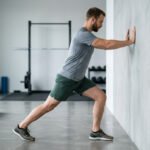
Kneel on your right knee with your left foot planted flat in front of you, knee bent. Tuck your hips slightly forward and squeeze your right glute until you feel a stretch along the front of your right hip and thigh. Keep your spine neutral rather than arching your lower back to fake extra range.
Hold this position for 30 seconds, then switch sides. Kneeling lunge stretches target hip flexors effectively, and this is one of the most useful stretches you can do if you spend most of your day sitting.
4. Figure Four Stretch
Lie on your back with both knees bent and feet flat on the floor. Cross your right ankle over your left knee, then gently pull your left thigh toward your chest until you feel a stretch through your right glute and outer hip. Keep your right foot flexed rather than pointed to protect your knee.
Hold for 30 seconds on each side. Pigeon pose is a more advanced variation of this same stretch if you want to progress it once the seated version feels easy.
5. Glute Bridge for Activation
Lie on your back with your knees bent and feet flat, about hip width apart. Press through your heels and squeeze your glutes to lift your hips toward the ceiling until your body forms a straight line from your shoulders to your knees. Hold briefly at the top, then lower with control.
This isn’t a stretch, it’s an activation exercise, and it matters just as much as the stretching. Tight hip flexors and weak glutes tend to travel together, so waking the glutes up helps your hips move better in every direction, not just the one you just stretched.
6. Single-Leg Hip Bridge
Once regular bridges feel easy, progress to single-leg hip bridges for a bigger glute and hip stability challenge. Set up the same way, then extend one leg straight while keeping the other foot planted. Press through the planted heel to lift your hips, keeping them level rather than letting one side dip.
Perform single-leg hip bridges for 10 to 15 repetitions on each side. This builds the strength that keeps your newly opened hip range from tightening right back up.
7. Clamshell
Lie on your side with your knees bent and stacked, hips stacked directly above each other. Keeping your feet together, lift your top knee as high as you can without rotating your pelvis backward. Lower with control and repeat.
Do 12 to 15 reps per side. This targets the muscles on the side of your hip that stabilize your pelvis when you walk, run, or stand on one leg, and it’s often the missing piece for people who stretch constantly but never see lasting change.
8. Lateral Band Walk
Place a resistance band just above your knees and stand with your feet hip width apart in a slight squat. Step your right foot out to the side, then bring your left foot in to match, keeping tension on the band the entire time. Take ten steps to the right, then ten steps back to the left.
Focus on keeping your knees tracking over your toes rather than caving inward. This exercise builds strength in the muscles on the side of your hip that most stretching routines skip entirely, and it pairs especially well with the clamshell above.
9. Deep Squat Hold
Stand with your feet slightly wider than shoulder width, toes turned out a bit, and lower into the deepest squat you can control while keeping your heels on the floor. Use your elbows to gently press your knees outward if that helps you settle into the position.
Hold for 20 to 30 seconds, breathing steadily rather than holding your breath. This is one of the best tests of overall hip mobility, and it also happens to be one of the best exercises for building it, since it takes your hips through flexion, abduction, and internal rotation all at once.
Work through this sequence three to four times a week for the best results. Hip mobility exercises improve overall hip function and reduce pain over time, but the improvement builds gradually rather than showing up after a single session.
When Hip Tightness Needs More Than Stretching
For most people, consistent mobility work like the routine above is enough to make a real difference within a few weeks. You should start noticing your squat feels deeper, your stride feels longer, and everyday movements like getting out of a chair feel less stiff.
That said, stretching and activation exercises aren’t a fix for every kind of hip problem. If your hips are tight because of true structural restriction, an old injury that never fully healed, or a movement pattern that’s become deeply ingrained, general exercises can plateau quickly. You might feel looser for an hour after stretching, only to tighten right back up.
Warning Signs Worth Paying Attention To
A few signals point toward something beyond simple stiffness. Sharp or pinching pain, rather than a stretching sensation, deserves attention rather than a heavier stretch. Pain that wakes you up at night, or that started after a fall or a specific injury, isn’t something to stretch your way through on your own.
Persistent stiffness that doesn’t budge after several weeks of consistent effort is another sign worth noticing. And if tightness in one hip is noticeably worse than the other despite equal effort on both sides, that asymmetry is worth having looked at rather than assumed away.
None of this means something is seriously wrong. It just means a physical therapist can identify exactly which structures are limiting you and build a plan that targets the real cause instead of guessing your way through months of stretching that isn’t holding.
How Physical Therapy Helps With Hip Mobility
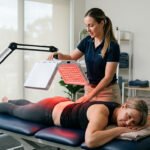
A physical therapist doesn’t just hand you a list of stretches and send you on your way. The evaluation starts with a movement assessment that identifies exactly which motions are restricted, which muscles are actually short versus just feeling tight, and whether the limitation is coming from the muscles, the joint capsule, or a stability problem elsewhere in the kinetic chain.
From there, treatment usually combines hands-on techniques with a targeted exercise plan. Manual therapy can address restrictions in the joint capsule and surrounding soft tissue that stretching alone won’t reach. Dry needling has shown positive results for pain and function in hip conditions, particularly for deeply tight muscles in the hip flexors and glutes that have been resistant to regular stretching. Strengthening work fills in the stability gaps that let your hips lose range in the first place.
This combination matters because stretching alone treats the symptom. If your hip flexors are tight because your glutes and core aren’t doing their job, stretching the hip flexors gives you temporary relief, but the tightness comes right back because the underlying weakness never got addressed. A physical therapist treats both sides of that equation at once.
How Scottsdale Physical Therapy & Performance Approaches This
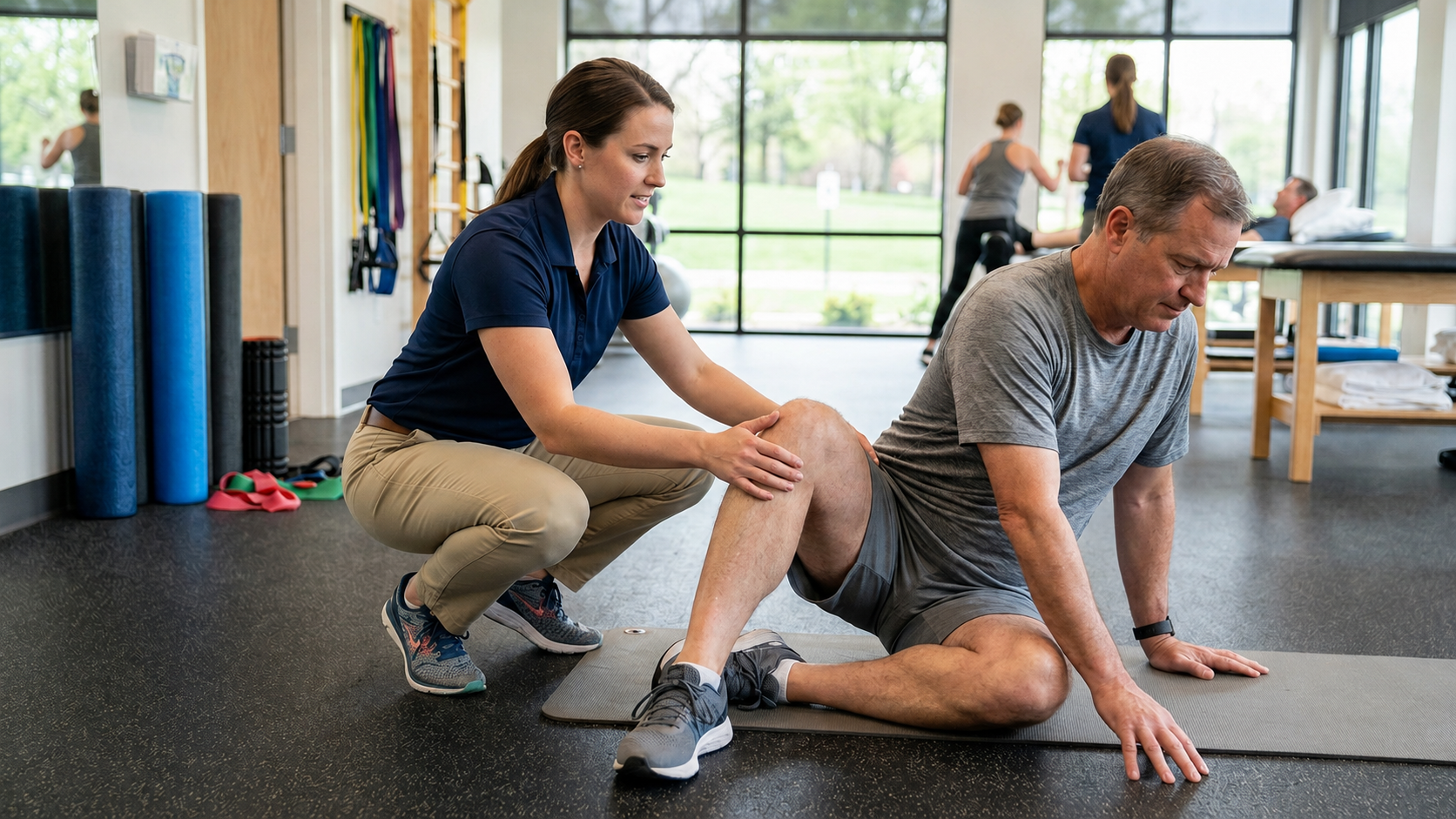
At Scottsdale Physical Therapy & Performance, hip mobility isn’t treated as an isolated complaint. Every evaluation looks at how your hips move in the context of what you actually do, whether that’s sitting at a desk all week, training for a race, or trying to keep up with weekend pickleball games without your back barking at you afterward.
Dr. John Dodson, DPT, works with a lot of golfers and weightlifters who come in with hip tightness that’s quietly limiting their performance long before it becomes painful enough to notice on its own. His approach combines dry needling with a structured mobility and strengthening plan, so patients leave with both immediate relief and a program they can keep using on their own.
For active adults who want to build lasting hip strength and control rather than just chasing flexibility, Grace De Haan’s personal training and performance coaching bridges that gap between physical therapy and long-term fitness. Once your hip mobility is where it needs to be, her programming helps make sure it stays that way.
If you’re a runner dealing with hip tightness specifically tied to your stride, our hip mobility guide for runners goes deeper into running-specific drills. Golfers looking to translate better hip mobility directly into swing power will find more detail in our golf swing hip mobility guide. This article is meant as the general starting point that applies no matter what brought you here.
Ready to Move Better?
Tight hips don’t have to be something you just live with. Whether you’re dealing with mild stiffness that’s starting to bother you or you’ve hit a wall with stretching on your own, a proper evaluation can save you months of guessing. Our team can pinpoint exactly what’s limiting your hips and build a plan that actually holds up over time, not just for a day or two after you stretch.
If you’re ready to find out what’s really going on, reach out to our team to schedule an evaluation. We’ll get you moving the way you’re supposed to move, whether that means getting back to your sport or just getting through your day without your hips reminding you they’re there.
Frequently Asked Questions
How Long Does It Take To Improve Hip Mobility?
Most people notice a difference within two to three weeks of consistent daily or near-daily practice. Full, lasting change in range of motion typically takes six to eight weeks, since you’re not just stretching tissue, you’re also building the strength to hold onto that new range.
Can I Still Work Out While Improving Hip Mobility?
Yes, and you generally should. Hip mobility work pairs well with your regular training rather than replacing it. Just make sure you’re not skipping the strengthening pieces like glute bridges and clamshells in favor of stretching alone, since strength is what makes new range stick.
Do I Need a Referral To See a Physical Therapist for Hip Tightness?
In Arizona, you can see a physical therapist directly without a referral from your doctor. If your insurance requires one for coverage purposes, our team can help you sort out what’s needed before your first visit.
Is It Normal for One Hip To Be Tighter Than the Other?
Some asymmetry is common, especially if you favor one side in your sport or daily activities. Significant or worsening asymmetry despite consistent effort on both sides is worth having evaluated, since it can point to a specific restriction rather than general tightness.
Should Hip Mobility Exercises Ever Hurt?
You should feel tension and a stretching sensation, not sharp or pinching pain. If a movement causes pain rather than a stretch, back off and try a gentler variation, or check in with a physical therapist before pushing further.