You’re on the 15th hole at one of Scottsdale’s beautiful desert courses. The sun is warm, the views are spectacular, but your lower back is talking to you. Your hips feel locked up. That smooth golf swing you had on the front nine now feels forced and abbreviated.
If this sounds familiar, you’re not alone. And here’s the reassuring news: most seniors between 60 and 85+ can safely improve their golf strength, balance, and flexibility with the right plan.
This article will walk you through practical solutions you can start using this week. We’ll cover a simple 10-minute pre-round warm-up you can do beside the cart, 6-10 safe strength and mobility exercises designed for senior golfers, and how physical therapy at Scottsdale PT & Performance can customize a program based on your body, your goals, and your favorite courses.
Whether you’re a year-round Scottsdale resident walking hilly fairways in the summer heat or a winter visitor looking to make the most of your golf season, these strategies apply to you.
What you’ll learn in this article:
-
Why aging affects your golf game and what you can do about it
-
Common reasons seniors feel stiff or unsteady on the course
-
A practical warm-up routine you can do before any round
-
The best golf exercises for seniors targeting legs, core, and upper body
-
Balance training drills for a steadier swing
-
When to seek help and how PT can build a safer fitness plan
What Is “Senior Golf Fitness” And Why It Matters After 60
Senior golf fitness is targeted strength training, mobility work, balance training, and endurance conditioning designed to support a comfortable, repeatable golf swing. Unlike general fitness programs, golf fitness focuses on the specific movement patterns your body uses during a round.
After roughly age 60, your body experiences predictable changes that directly affect how you play.
Muscle mass naturally decreases with each passing decade. Your joints may have less cartilage cushioning. Balance and reaction time slow down. These aren’t reasons to quit. They’re reasons to train smarter.
Here’s how these changes show up on the golf course:
-
Shorter drives: Less muscle mass means less power generation through the swing
-
Back tightness on the back nine: Reduced thoracic spine mobility forces your lower back to compensate
-
Difficulty walking uneven terrain: Weaker ankles and reduced balance make slopes, bunkers, and desert washes around courses like TPC Scottsdale or Grayhawk feel more challenging
-
Fatigue earlier in the round: Cardiovascular conditioning declines, affecting both physical stamina and mental focus
The golf swing requires coordinated movement through your hips, thoracic spine, shoulders, and core. Your hips initiate the weight shift. Your thoracic spine (mid-back) allows rotation while your lower back stays stable. Your shoulders control the club path. Your core ties everything together.
When any of these areas lose mobility or strength, the whole chain compensates. That compensation often leads to discomfort, inconsistency, and reduced swing speed.
The good news: each of these areas responds well to targeted training at any age.
Common Reasons Seniors Feel Stiff Or Unsteady On The Course
Before jumping into exercises, it helps to understand what might be contributing to how you feel during a round. Keep in mind these are possible causes, not definitive diagnoses. A proper evaluation can help identify which factors apply to your situation.
Here are common contributors to stiffness, fatigue, and unsteadiness in senior golfers:
-
Age-related muscle loss (sarcopenia): This natural decline in muscle mass affects your push-off on the lead leg during the downswing, reducing clubhead speed and making it harder to maintain good posture through 18 holes.
-
Limited hip rotation: Tight hip flexors and reduced hip mobility force your lower back to over-rotate during the swing. This places undue stress on lumbar structures and often leads to that familiar ache by the back nine.
-
Restricted thoracic spine mobility: When your mid-back can’t rotate freely, you’ll struggle to achieve a full backswing. Many golfers compensate by swaying or sliding, which reduces power and consistency.
-
Poor balance and ankle weakness: Uneven fairways, sloped lies, and bunker edges become more challenging when your proprioception (body awareness) and ankle stability decline. This increases fall risk and affects your golf stance stability.
-
Sedentary off-season habits: Long periods of inactivity whether from winter months in colder climates or extended travel to Arizona, de-condition your body quickly. Even a few weeks without movement can reduce leg strength and cardiovascular capacity.
-
Past injuries and surgeries: Knee replacements, rotator cuff repairs, lumbar stenosis, or healed fractures change how your body loads the swing. These aren’t necessarily limitations, but they may require modified approaches to exercise and movement.
-
Dehydration in desert conditions: Playing in Scottsdale’s dry climate without adequate hydration may lead to muscle cramping, fatigue, and reduced mental focus by the later holes.
How Senior Golf Fitness Helps Your Game And Daily Life
The benefits of a consistent fitness routine extend well beyond your scorecard. The same exercises that improve your swing also make daily life easier and more enjoyable.
Here’s what senior golfers often notice when they commit to a golf fitness program:
-
Stronger legs for walking 18 holes: Improved leg strength means you can choose to walk the course instead of riding, or at least walk from the cart to your ball without feeling winded. Chair squats are a safe and effective exercise for seniors to build this leg strength.
-
Better core stability for back comfort: A strong core protects your spine during rotation and reduces that familiar low back ache that builds through a round. Resistance band rotation exercises are a cornerstone of modern golf fitness, offering a low-impact method to build functional strength exactly where you need it most.
-
Improved shoulder mobility for a full backswing: When your shoulders move freely, you can achieve a longer, more powerful golf swing without forcing the movement.
-
More stable balance stepping in and out of bunkers: Enhanced proprioception and ankle strength help you navigate uneven terrain with confidence.
-
Increased bone density from resistance work: Weight-bearing exercise can support bone health, which may help lower fracture risk over time.
-
Greater confidence joining leagues and traveling: When you feel strong and capable, you’re more likely to say yes to golf trips, tournaments, and social rounds with friends. Golf provides opportunities for social interaction, which is crucial for mental well-being in seniors.
-
Overlap with everyday function: The chair squats that strengthen your legs for golf also help you get out of low restaurant booths. The balance work that steadies your swing also helps you carry groceries up stairs.
-
Mental benefits: Activities that combine movement, focus, and social connection are linked with brain health as we age.
-
Ongoing learning: Golf is a sport that seniors can continually improve upon, providing ongoing opportunities for learning and personal challenges.
This isn’t about chasing your 30-year-old distances. It’s about maintaining an active lifestyle and continuing to enjoy golf for as many years as possible.
When Senior Golf Fitness Needs A Safety Check: Red Flags
Mild soreness or stiffness after a round can be common, especially if you have not played or trained recently. However, some signs mean you should pause your exercise routine and get checked before continuing.
Seek immediate or same-day medical care for:
-
Sudden chest pain, pressure, or tightness on the course or during exercise
-
New shortness of breath at rest or with minimal exertion
-
Fainting or near-fainting episodes
Neurological red flags requiring urgent evaluation:
-
Sudden loss of balance that feels different from your usual unsteadiness
-
New weakness or numbness in an arm or leg, especially on one side
-
Trouble speaking, sudden confusion, or severe headache (possible stroke signs)
Musculoskeletal red flags warranting prompt physician review:
-
Severe back pain after a swing that doesn’t ease with rest
-
Inability to bear weight on a leg after stepping awkwardly
-
Visible joint deformity or significant swelling after a fall or twist
If you’re unsure whether something is serious, call your primary care provider or 911 rather than trying to stretch it out or walk it off.
For most non-emergent pain, stiffness, or movement concerns, a physical therapist is an appropriate first stop. In Arizona, you can often see a PT without a referral, but insurance rules can vary.
Warm-Up: A 10-Minute Pre-Round Routine For Seniors
A proper warm-up before your round can make a noticeable difference in how you feel through all 18 holes. This routine is designed to be done beside the cart at courses like Talking Stick, Papago, or any of your favorite Scottsdale tracks.
The goal is to feel loose, warm, and ready to swing not exhausted before you hit your first tee shot.
Dynamic warm-ups using active movements are preferred over static holds before playing a round of golf.
Step 1: Easy Walking Or Marching In Place (2-3 Minutes)
Start with simple movement to raise your heart rate gently. Walk around the parking lot or practice area, or march in place with arms swinging naturally. This gets blood flowing to your muscles.
Step 2: Shoulder Circles With Or Without A Golf Club (10-15 Each Direction)
Stand upright with feet hip width apart. Gently rotate your shoulders in circles, forward then backward. If you have a golf club, hold it in front of you with arms extended and make slow circles. Move to a mild stretch, not pain.
Step 3: Trunk Rotations Hugging A Club (10-15 Each Side)
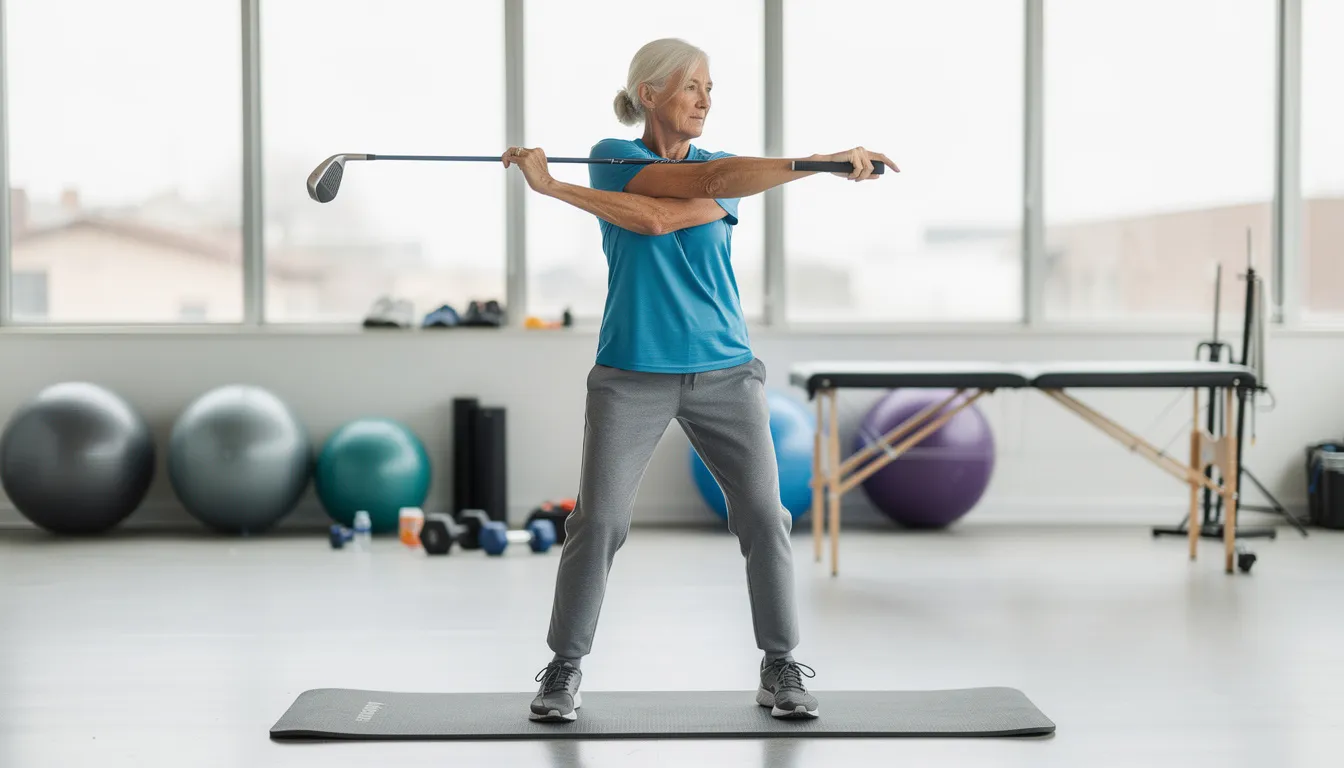
Hold a golf club across your chest, keeping your core engaged. Rotate your upper body left and right, mimicking the rotational movement of your swing. Keep knees bent slightly and feet flat on the ground. Gently rotate through a comfortable range.
Step 4: Dynamic Hip Swings Holding The Cart (10-12 Each Leg)
Hold onto the golf cart or a sturdy surface for balance. Swing one leg forward and backward in a controlled pendulum motion. This opens up the hip flexors and prepares your hips for the weight shift in your swing.
Step 5: Ankle Pumps And Circles (15-20 Each Foot)
While seated in the cart or standing with support, pump your ankles up and down, then make slow circles. This is especially important if you ride a cart, as your ankles stay relatively still during the round.
Step 6: Standing Weight Shifts (8-10 Each Direction)
With feet shoulder width apart, shift your weight from left foot to right foot, feeling your hips move laterally. This mimics the weight transfer in a proper golf swing and wakes up your balance system.
This warm-up should feel easy and energizing. Practice it at home a few times so it becomes second nature before your round.
How To Use This Plan
If you play golf 2 times per week, aim to do this exercise routine on 2 non-golf days.
If you are deconditioned or new to exercise, start with 10-minute sessions 3 times per week and gradually increase as you build strength and confidence.
Pick 4 to 6 exercises per session rather than trying to do them all at once. This approach helps avoid overuse and keeps workouts manageable.
Always listen to your body. If you have osteoporosis, joint replacements, or other physical limitations, modify exercises as needed and use support (chair, counter) when necessary.
Best Strength & Mobility Exercises For Senior Golfers
Here are recommended exercises targeting your lower body, core, upper body, and overall mobility. These movements are selected for their safety, effectiveness, and direct application to the golf swing.
Aim for 1-2 sets of 8-10 repetitions, performed 2-3 times per week. If you are new to strength work, start with 1 set of 6 to 8 reps and build weekly. Start with fewer reps or sets if needed and build slowly over several weeks.
Beginner Exercises
-
Chair squats: Stand in front of a sturdy chair with feet shoulder width apart. Slowly lower yourself toward the seat as if sitting down, then stand back up using your leg strength. Keep your chest lifted and knees tracking over your toes. Builds leg strength essential for a stable golf stance and walking the course.
-
Heel raises: Stand near a counter or sturdy chair for balance. Rise up onto your toes, hold briefly, then slowly lower. Strengthens calves for push-off power and stability on slopes and uneven terrain.
-
Seated trunk rotations: Sit in a chair or stand holding a counter. Place your hands behind your head with elbows wide. Gently rotate your upper body side to side. Improves thoracic spine mobility for a fuller backswing.
-
Resistance band rows: Attach a resistance band to a doorknob or hold it with arms extended. Pull the band toward your ribs, squeezing your shoulder blades together. Slowly release. Strengthens muscles between shoulder blades, improving posture and swing control.
Intermediate Exercises
-
Bridges: Lie on your back with knees bent and feet flat. Lift hips toward the ceiling by squeezing glutes, creating a straight line from knees to shoulders. Hold 2-3 seconds, then lower. Supports lower back during rotation.
-
Band pull-aparts: Hold a resistance band in front at shoulder height. Pull hands apart until band touches chest, then control return. Builds upper body stability for consistent club control.
-
Incline push-ups: Place hands on a counter or sturdy chair. Lower chest toward surface by bending elbows, then push back up. Builds chest and arm strength without stressing shoulders.
-
Resistance band rotation exercises: Secure a band at waist height. Hold with both hands and mimic golf swing rotation slowly and controlled. Strengthens core muscles responsible for power and stability during swing.
-
Pallof press: Stand sideways to a band anchored at chest height. Hold band with both hands and press straight out, resisting rotation. Strengthens anti-rotation core muscles, enhancing stability.
-
Goblet squats: Hold a light weight close to your chest, perform squats maintaining good posture. Improves lower body power and supports strong golf stance.
Optional Add-Ons
To strengthen weak shoulders, try the following exercises:
-
Band external rotations: Hold a resistance band with elbows bent at sides. Rotate forearms outward. Safer for shoulder health than some shoulder raises.
-
Gentle yoga poses: Consider poses like Cat-Cow, Child’s Pose, and Seated Spinal Twist to improve flexibility and balance. Practice slowly and avoid any positions causing pain.
Common Concerns Addressed
If you have osteoporosis, arthritis, joint replacements, or fear of falling, use support during standing exercises. Move slowly and breathe out during exertion.
Stop any exercise if you experience sharp or worsening pain. Mild muscle fatigue is normal, sharp joint pain is not.
If any movement consistently causes symptoms, consult a physical therapist. Exercises can often be modified rather than stopped.

Balance And Weight-Shift Drills For A Steady Swing
Balance training is essential for both swing consistency and fall prevention. These drills help you develop the stability needed for clean contact and safe navigation of Scottsdale’s desert courses.
-
Single-leg stance with support: Stand near a counter or sturdy surface. Lift one foot slightly off the ground and balance on the other. Hold for 10-20 seconds, then switch. As you improve, reduce how much you hold the counter.
-
Heel-to-toe walking: Walk in a straight line, placing your heel directly in front of your opposite toes with each step. This challenges your balance system in a controlled way. Perform near a wall or counter for support if needed.
-
Side-to-side weight shifts: With feet shoulder width apart, shift your weight fully onto your left foot, then onto your right foot. This mimics the weight transfer in a proper golf swing. Perform 8-10 controlled shifts each direction.
-
Supported mini lunges: Hold a counter or cart for balance. Step one leg forward into a small lunge, keeping your torso upright. Push back to starting position. Builds strength and stability through hip range of motion used in the swing.
Safety reminders:
-
Perform balance work near a counter or wall.
-
Avoid wet or slippery surfaces.
-
Have someone nearby if your balance is very limited.
-
Start with 10-20 seconds per leg or 8-10 controlled shifts.
-
Progress by increasing time or reducing hand support.
Smoother weight shift often translates to better ball contact and less compensatory strain on your lower back.
At-Home Relief Strategies For Common Golf Aches
After a round, mild soreness is common. Here are gentle ways to settle typical golf-related aches like low back stiffness, shoulder tightness, or knee discomfort after walking 18 holes.
-
Take short walking intervals instead of prolonged sitting: After your round, avoid sitting for long periods. Brief walks every 30-45 minutes help muscles recover and reduce stiffness.
-
Gentle stretching of hips, hamstrings, and chest: Later the same day, spend 10-15 minutes stretching muscle groups that worked hardest. Focus on hip flexors, hamstrings, chest, and shoulders.
-
Use ice or heat based on what feels better: Apply ice or heat for 10-15 minutes with a layer between skin and pack. Ice often helps acute soreness; heat may feel better for muscle tightness.
-
Light mobility work for mild back tightness: Gentle pelvic tilts or cat-camel movements often feel better than complete rest.
-
Stay hydrated after your round: In dry heat, you may lose more fluid than you notice, especially if you do not feel sweaty. Continue drinking water through the afternoon and evening.
-
Avoid the “no pain, no gain” mindset: Discomfort should be tolerable and improve over 24-72 hours. If it intensifies or lasts beyond a week, schedule a PT evaluation.
-
Gentle walking the next day: Light activity typically promotes recovery better than complete rest for most muscle soreness.
If symptoms worsen or persist beyond 5-7 days, it’s worth having a professional assess what’s happening.
How Physical Therapy Builds A Safer Senior Golf Fitness Plan
A golf-focused physical therapy evaluation at Scottsdale PT & Performance starts with a conversation about your specific goals, whether that is walking 18 at Troon North without back pain, adding yards to your drives, or simply keeping up with your regular foursome for another decade.
From there, we’ll conduct a movement screen, test your strength and balance, and review any relevant medical history. If you’ve had a knee replacement, shoulder surgery, or spinal procedure, we’ll factor that into every recommendation.
What PT provides that generic programs can’t:
-
Identification of which joints are truly stiff versus just weak or guarded
-
Testing of single-leg balance, step-up strength, and rotational control
-
Observation of your golf stance and swing pattern, possibly with a weighted club in the clinic
-
A personalized exercise program adjusting for arthritis, spinal stenosis, joint replacements, or osteoporosis
-
Progression from chair-based simple exercises to more golf-like targeted movements as tolerated
-
Coordination with your local golf pro if you’re already working with an instructor, to align swing changes with your physical limitations and capacity
-
Clear guidance on exercise regimen modifications when something doesn’t feel right
PT visits focus on coaching and consistent practice, not just passive treatments. Your home program will be kept realistic, typically 10-20 minutes most days, because we know you won’t do a 90-minute routine.
Some people notice improvements in comfort, balance, or stamina within a few weeks, but timelines vary based on health history, consistency, and starting point.
Staying On The Course Longer: Prevention And Smart Training Habits
Think of this as playing the long game making choices in your 60s, 70s, and 80s that keep you golfing as long as possible.
Prevention tips for sustainable golf fitness:
-
Aim for at least two strength days and two walking/cardio days each week: This provides the minimum effective dose for maintaining muscle and cardiovascular health. Adjust based on your current health status.
-
Gradually ramp up after an off-season or injury: If you’ve been away from golf, start with 9 holes for 1-2 weeks before jumping back to full rounds. Your body weight and swing mechanics need time to readjust.
-
Schedule rest days between heavy golf days: In hot Scottsdale summers especially, avoid playing 36 holes on consecutive days. Recovery matters more as we age.
-
Stay ahead of hydration needs: Start drinking water before your round, not just during. Desert conditions require proactive fluid intake.
-
Maintain good posture during your round: Stand upright between shots. Avoid prolonged forward bending over your bag or cart.
-
Keep your fitness routine going year-round: Muscle memory and strength fade faster than you’d expect during extended breaks.
-
Consider periodic PT tune-ups: Once or twice a year, even when you feel good, a quick reassessment can catch developing issues before they become problems.
-
Make small, consistent changes: Ten minutes of daily exercise usually produces better long-term results than occasional intense workout bursts.
Your goal isn’t to train like a tour player. It’s to build and maintain the physical capacity to enjoy golf for years to come.
Senior Golf Fitness FAQ
Am I Too Old To Start A Golf Fitness Program If I’m Over 70 Or 80?
Many studies show older adults can improve strength and function with appropriately scaled resistance training and mobility work, when progressed gradually. The key is starting at an appropriate level and progressing slowly.
How Many Days Per Week Should I Train If I Play 1-3 Rounds At Courses Around Scottsdale?
For most senior golfers playing 1-3 times weekly, aim for 2-3 strength and mobility sessions on non-golf days, plus 2-3 days of light cardio like walking. This doesn’t need to be time-consuming—20-30 minutes of focused golf exercises can make a substantial difference. On days you play, your warm-up routine counts as part of your training.
Is It Safe To Lift Weights If I Have Arthritis Or A Joint Replacement?
In most cases, yes and it’s often beneficial. Strength training with proper form helps protect arthritic joints by building supporting muscles. After joint replacements, strengthening the surrounding muscles is typically a key part of rehabilitation. The specifics depend on your situation, which is why working with a physical therapist who understands both your condition and golf’s demands is valuable.
How Long Does It Usually Take To Notice Changes In My Swing Or Stamina?
With a consistent exercise program, some people notice improvements in comfort, balance, or stamina within a few weeks, but timelines vary based on health history, consistency, and starting point. Changes in swing speed and distance may take 8-12 weeks as your body builds muscle memory and strength. Patience and consistency matter more than intensity. Mental well-being often improves even faster as you feel more capable and confident.
Should I See A PT Or My Golf Pro First If My Swing Hurts?
If swinging the club causes pain, start with a PT evaluation. Pain indicates something in your body isn’t tolerating the movement well, and understanding that physical limitation should come before swing instruction. Once you’ve addressed the physical issue, your golf pro can help refine your technique within your body’s current capacity. Many patients work with both simultaneously for best results.
Can I Do These Exercises If I Have Balance Problems?
Yes, with appropriate modifications. All the balance drills and exercises in this article can be performed with support from a counter, wall, sturdy chair, or even a partner nearby. Building balance is especially important if you currently feel unsteady. Start with maximum support and gradually reduce it as your confidence and stability improve.
Medical Disclaimer
This article provides general educational information about senior golf fitness and is not intended as medical advice, diagnosis, or treatment for any individual condition.
The exercises and suggestions described may not be appropriate for everyone, particularly those with complex medical histories, recent surgeries, or unstable health conditions.
Before beginning a new exercise regimen, especially if you have existing pain, cardiovascular concerns, or have been sedentary for an extended period, consult a healthcare professional, including a licensed physical therapist, who can evaluate your specific situation and provide personalized guidance.
Ready To Keep Playing Strong? Work With Scottsdale PT & Performance
If you’re a senior golfer in the Scottsdale or Phoenix area looking to stay active on the course, we’d welcome the opportunity to help you build a personalized golf fitness plan.
Your first visit at Scottsdale PT & Performance includes a conversation about your specific goals, whether that is walking all 18 at your favorite course without pain, adding yards to your drives, or simply keeping up with your regular playing partners. We’ll test your movement, strength, and balance, then create a clear written plan you can follow. If you’re experiencing discomfort or reduced mobility, it might be time for a physical therapy check-up.
Previous fitness level doesn’t matter. Whether you’re new to structured exercise or have been active your whole life, we customize every program to where you are right now.
Call us or book online to schedule your golf-focused PT evaluation.
Your next round could feel better than you expect. Let’s build a plan that keeps you on the course with less pain, more confidence, and more years of enjoyable game ahead.