
Sciatica Vs Piriformis Syndrome (What’s Most Likely Going On?)
Both sciatica and piriformis syndrome irritate the same nerve, the sciatic nerve but they do it from different locations. Sciatica usually starts with a problem in the lower spine. Piriformis-related irritation is one possible cause of sciatic nerve irritation in the deep gluteal space, often grouped under deep gluteal syndrome.
Most Likely Causes Based on Your Symptoms
Most likely sciatica if:
- You have lower back pain along with leg pain
- Pain travels past your knee into your calf, ankle, or foot
- Coughing, sneezing, or bearing down makes the pain spike
- You notice weakness in specific muscles (trouble walking on heels or toes)
Most likely deep gluteal or piriformis-type irritation if:
- You feel a deep ache right in the middle of one buttock
- Sitting especially on a wallet or hard surface makes it worse
- Pain often stays above the knee, but it can travel farther in some cases
- Standing and walking actually feel better than sitting
The reassuring news: both conditions are usually treatable without surgery or invasive treatments. A thorough physical therapy evaluation is often the best next step to get an accurate diagnosis and start the right treatment plan.
One important note: severe weakness in your leg, loss of bowel or bladder control, or numbness in your groin area are red flags that need urgent medical attention. We’ll cover those in detail below.
What’s Actually Happening? (Simple Anatomy And Definitions)
Both conditions involve the sciatic nerve, but they irritate it at different points along its path.
The sciatic nerve is the largest nerve in your body. It forms from nerve roots in your lower spine (L4–S3) and runs from your low back through your buttock and down the back of each leg. When something irritates this nerve at any point you can experience sciatic pain, numbness, or tingling.
True sciatica refers to symptoms caused by nerve compression or irritation at the spinal level. Common culprits include:
- A herniated disc pressing on a nerve root
- Spinal stenosis (narrowing of the spinal canal)
- Bone spurs from degenerative changes
With true sciatica, pain often starts in the low back and radiates through the buttock, down one leg, and sometimes all the way to the foot.
Piriformis-related irritation occurs when the piriformis muscle or other structures in the deep gluteal space compress or irritate the sciatic nerve. The piriformis is a small muscle that runs from your sacrum (the triangular bone at the base of your spine) to the top of your thigh bone. The sciatic nerve passes directly under this muscle and in some people, it passes through it.
When piriformis-related irritation happens, the muscle or surrounding tissues press on the sciatic nerve in the buttock area. This creates pain that can mimic sciatica symptoms but originates from muscle tension or other deep gluteal causes rather than a spinal issue.
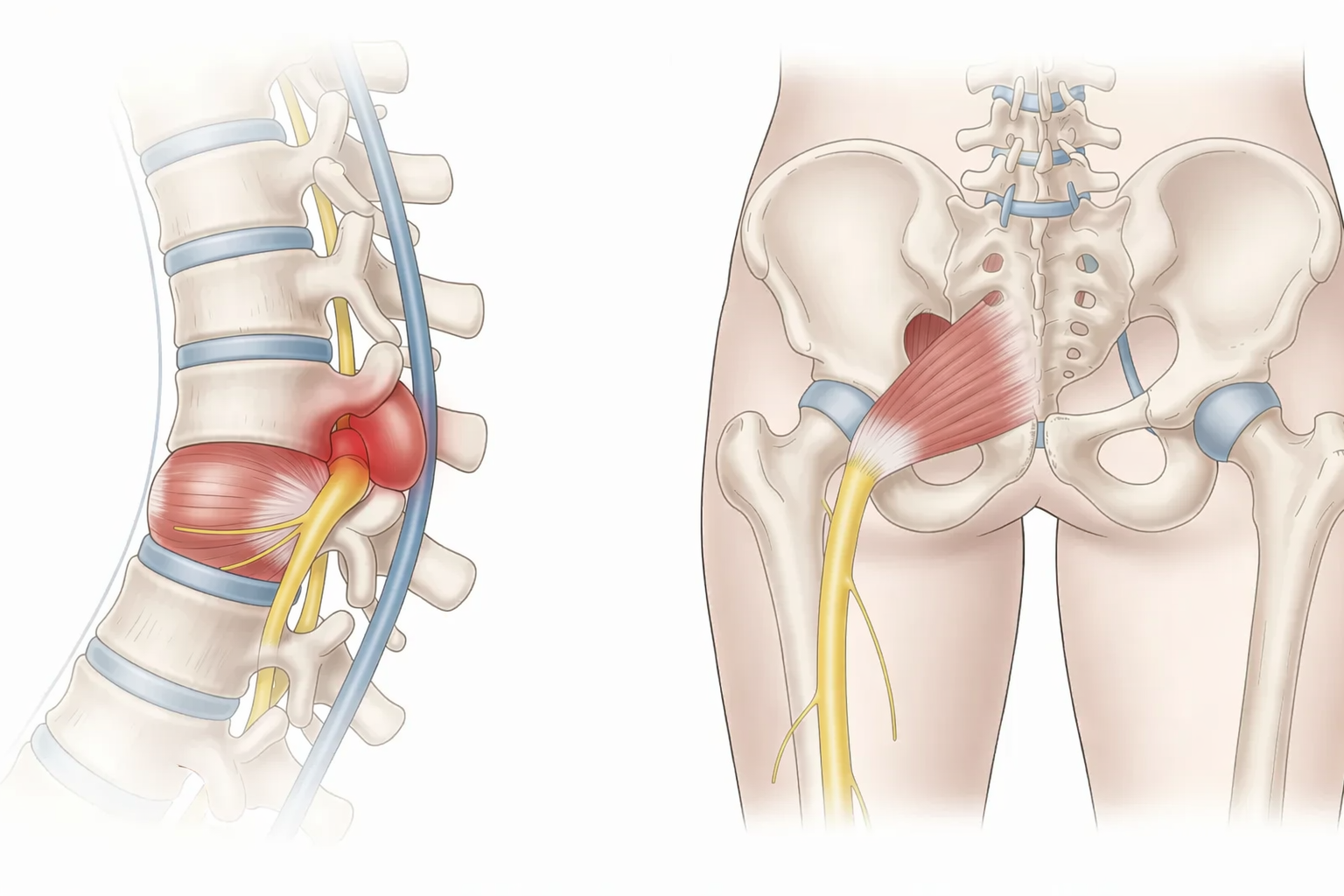
Here’s why this matters: imaging is often more useful for spine causes than for deep gluteal causes, and diagnosis is usually clinical meaning a hands-on exam and detailed history are usually more valuable than pictures.
Common Causes And Risk Factors
Understanding what triggers each condition helps explain why treatment approaches differ.
Sciatica (Spine-Related) Causes:
- Lumbar disc herniation: Often happens after a bend-twist-lift movement picking up a heavy box, moving furniture, or a sudden gym mishap. Most common in your 30s–50s.
- Lumbar spinal stenosis: Gradual narrowing of the spinal canal that compresses nerve roots. More common after age 50.
- Degenerative disc disease and bone spurs: Age-related changes in the lower spine that can irritate nearby nerves.
- Spondylolisthesis: One vertebra slipping forward on another, pinching nerve tissue.
- Occupational factors: Repetitive heavy lifting, frequent bending, or whole-body vibration (long-haul driving, construction work).
Piriformis-Related Causes:
- Prolonged sitting: Desk work, long drives on the I-10, or extended flights put constant pressure on the piriformis.
- Direct trauma: A fall onto your hip, a sports collision, or prior hip surgery can trigger piriformis irritation.
- Training changes: Rapid increases in running or hiking volume especially hills and trails can overload the piriformis.
- Weak glutes: When your gluteal muscles are under-active, the piriformis works overtime and becomes a tight muscle prone to spasm.
- Sitting on a wallet: This can contribute to buttock compression and nerve irritation, though it is just one of many possible factors.
Risk Factors For Both Conditions:
- Long sedentary stretches without movement breaks
- Poor trunk and hip strength
- Limited hip mobility
- Deconditioning after illness, injury, or a break from exercise
Important: Some people have both conditions at the same time. A lumbar spine issue can irritate a nerve root while a protective piriformis spasm adds extra sciatic nerve compression in the buttock. This is why a thorough assessment matters treating only one layer may leave you stuck.
How The Symptoms Differ: Sciatica Versus Piriformis Syndrome
Self-diagnosis is imperfect, but recognizing patterns can help you describe your symptoms more clearly to a provider.
Typical Sciatica Pattern:
- Pain often starts in the low back or upper buttock and radiates down one leg
- Pain frequently travels below the knee into the calf, ankle, or foot
- Quality feels sharp, electric, burning, or like sudden “zingers”
- Coughing, sneezing, or bearing down often makes symptoms spike
- You may notice numbness, tingling, or weakness in specific areas (difficulty walking on heels or toes)
- Sciatica symptoms often show gradual worsening as spinal problems advance
Typical Piriformis Syndrome Symptoms:
- Deep, pinpoint buttock pain often described like “sitting on a golf ball or rock”
- Pain may radiate down the back of the thigh but often stays above the knee, though it can travel farther in some cases
- Standing and walking often feel better than prolonged sitting
- Tenderness when pressing right over the piriformis (mid-buttock, slightly toward the outside)
- Symptoms flare with positions that stretch or load the piriformis: crossing legs, climbing stairs, lunges, or internal rotation of the hip
- Pain piriformis syndrome causes tends to be erratic and activity-dependent rather than steadily worsening
Quick Comparison:
| Feature | Sciatica (Spine-Related) | Piriformis Syndrome |
|---|---|---|
| Pain Starting Point | Low back, radiating down | Deep in one buttock |
| How Far Pain Travels | Often to foot/toes | Usually stops at mid-thigh, but can vary |
| What Makes It Worse | Spinal movements, coughing, sneezing | Hip movements, sitting, climbing stairs |
| Associated Signs | Back stiffness, possible foot drop | Deep buttock tenderness, sitting pain |
| Progression | Often gradual worsening | Erratic, activity-dependent |
Because these conditions share similar symptoms, a hands-on physical exam is often the key to teasing them apart. Your pain pattern matters, but so does how your body responds to specific tests.

Red Flags: When To Seek Urgent Or Emergency Care
Most leg pain and buttock pain is not an emergency. However, certain symptoms require same-day medical attention.
Seek urgent care if you experience:
- New or rapidly worsening weakness in your leg or foot (foot drop, inability to lift your toes, difficulty rising from a chair)
- Loss of bowel or bladder control, or new trouble starting or stopping urination
- Numbness in your groin or “saddle” area (inner thighs, buttocks)
- Severe pain that is unrelenting, does not change with any position, and prevents sleep entirely
- Significant trauma (fall from height, car accident) followed by back or leg pain
If you have any of these signs, go to the emergency department or call your physician immediately. Do not wait for a routine PT visit.
If your symptoms are bothersome but stable pain that comes and goes, intermittent tingling, stiffness that improves with movement an evaluation at a physical therapy clinic within a few days is reasonable and often the most efficient path forward.
Recovery Timeline
- Disc-related sciatica often improves within 6–12 weeks for many people with proper care.
- Piriformis-related irritation typically improves within 2–6 weeks with consistent treatment.
- If symptoms are worsening, you experience progressive weakness, or have red flags, seek medical attention immediately.
What You Can Try At Home Right Now (Without Making Things Worse)
Home care can help you manage discomfort while you wait for a professional assessment. The goal is gentle trial-and-error, staying below a “3–4 out of 10” pain level during any movement.
General Tips For Both Sciatica And Piriformis-Type Pain:
- Take short walks on flat ground (5–10 minutes, 1–3 times daily) if walking eases your back pain
- Avoid staying in one position sitting or standing for more than 30–45 minutes
- Use a small pillow or rolled towel behind your low back when sitting to maintain a comfortable, neutral spine
- Apply ice or heat (whichever feels better) for 10–15 minutes to reduce inflammation and calm muscle spasms
Ideas That Often Help Piriformis-Dominant Pain:
- Gentle stretching: Try a figure-four stretch on your back (ankle resting on opposite knee) held for 20–30 seconds, 2–3 times each side only if it doesn’t increase tingling
- Relaxation position: Lie on your back with knees bent and let both knees fall slightly apart to relieve tension in hip external rotators
- Cold pack: Apply to the deep buttock for 10–15 minutes after long periods of sitting
- Remove the wallet: If you carry a wallet in your back pocket, consider removing it before sitting to reduce pressure
Ideas That Often Help Spine-Dominant Sciatica:
- Prone on elbows: Lie on your stomach and prop yourself on your forearms for 30–60 seconds. This may help if it centralizes leg pain (moves it from the leg back toward the spine)
- Gentle pelvic tilts: On your back with knees bent, rock your pelvis gently to explore a comfortable mid-range spinal position
- Alternating temperature: Try switching between cold and heat on the lower back for 10–15 minutes to calm muscle guarding
For more exercises to relieve lower back pain, explore this resource.
Important Cautions:
- Stop any exercise that causes new numbness, spreading tingling, or sharp shooting pain below the knee
- Avoid aggressive stretching or using hard balls for self-massage directly on very irritable nerve pain
- Skip movements that reproduce symptoms or push pain further down your leg
Home care is for short-term relief. If symptoms persist beyond 1–2 weeks, or if they’re getting worse, it’s time for a professional assessment.
How A Physical Therapist In Scottsdale Actually Tells Them Apart
At a Scottsdale PT & Performance evaluation, you’ll get a one-on-one session focused entirely on understanding your movement and your symptoms.
What The Assessment Includes:
Detailed History:
- When did this start? Was there a specific injury or incident?
- What are your daily activities, job demands, and hobbies?
- What makes symptoms better or worse?
- How is this affecting your sleep, work, or exercise?
Symptom Mapping:
- Where exactly does your pain start?
- How far does it travel?
- Does it change with different positions or activities?
Functional Movement Tests:
Spine-Focused Tests:
- Repeated flexion and extension movements
- Forward bending assessment
- Slump test and straight leg raise to check for nerve root irritability
Hip-Focused Tests:
- FAIR test (flexion, adduction, internal rotation) to reproduce symptoms specific to piriformis syndrome
- Resisted external rotation
- Palpation of the deep buttock to identify if piriformis muscle tension reproduces your pain
Neurological Screening:
- Strength testing: side-to-side comparison of calf strength, ankle movements, and big toe lift
- Sensation testing: light touch along specific nerve pathways when appropriate
- Reflex checks
Diagnostic Humility Matters
Sometimes the lumbar spine and piriformis both contribute to symptoms. In these cases, we often treat both layers initially and refine the plan as your body responds.
If red flags or atypical findings emerge during the exam, we coordinate with your physician for imaging or specialist referral.
Here’s the good news: imaging (MRI, X-ray) is not always needed first especially for straightforward mechanical patterns that improve with the right movements. A proper diagnosis often comes from the physical exam itself.
How Treatment Differs: Sciatica Vs Piriformis Syndrome In Physical Therapy
Both conditions respond well to conservative therapies, but the focus of piriformis syndrome treatment versus sciatica treatments is quite different.
For Spine-Related Sciatica, PT Priorities Include:
- Calm the irritated nerve root: We find positions and exercises that centralize your pain (move it from the leg back toward the spine). This might mean repeated extension exercises for some people, or flexion-based work for others it depends on your response.
- Nerve glides: Gentle sciatic nerve flossing is introduced only when appropriate. For highly irritable symptoms, we wait until things calm down first.
- Progressive strengthening exercises: Planks, bridges, bird dogs, and other core and hip exercises all tailored to your tolerance and gradually progressed.
- Ergonomic coaching: We review your workstation setup, lifting technique, and even your car seat position to alleviate symptoms during daily life.
For Piriformis Syndrome, PT Priorities Include:
- Reduce piriformis spasm: Manual therapy, soft tissue work, and specific stretching target the tight muscle directly.
- Strengthen supporting muscles: When glute max, glute med, and deep rotators are strong, the piriformis doesn’t have to “do all the work.” Exercises like clamshells, side steps, and hip thrusts build this capacity.
- Correct movement patterns: If symptoms started with a change in running or hiking, we look at gait and mechanics to find the root cause.
- Modify sitting habits: Removing the back-pocket wallet, using a supportive cushion, and adjusting seat angles can make a significant difference.
Both Treatment Plans Progress Over Time:
- Phase 1: Pain-calming strategies and movement exploration
- Phase 2: Building tolerance to load and range of motion
- Phase 3: Return to normal activities gym workouts, hiking, golf, pickleball, or whatever matters to you. To learn more about the different approaches that can support your recovery, check out this resource on the 6 types of physical therapy and their benefits.
Our role is to coach safe progress, not just hand you a sheet of exercises. We adjust the plan week by week based on how you respond, because proper treatment requires ongoing attention to your body’s signals.

Staying Better: Prevention And Return-To-Activity Tips
Once your pain improves, the focus shifts to keeping it that way through daily habits and smart training decisions.
General Prevention Habits:
- Break up long periods of sitting with 1–2 minute movement breaks every 30–45 minutes
- Maintain a consistent walking or light cardio routine 3–5 days per week
- Keep a simple home program: 5–10 minutes of core and hip work most days goes a long way
- Maintain a healthy weight to reduce load on your spine and hips
For Sciatica-Prone Backs:
- Practice neutral-spine lifting mechanics for yard work, picking up kids, and gym sessions
- Avoid sudden jumps in training volume increase running, biking, or strength training gradually over 1–2 weeks
- Use proper support (good shoes, appropriate surfaces) for repetitive impact activities
- Be mindful of heavy lifting technique, especially with twisting motions
For Piriformis-Prone Hips:
- Regularly stretch hips in a comfortable range: figure-four, hip flexor stretches, gentle stretching for rotation
- Vary sitting positions throughout the day and avoid very soft couches for long periods
- Use a firm, supportive office chair
- Warm up hips before hikes with a few activation drills (mini-squats, lateral steps, leg swings)
Consider Periodic Tune-Ups:
If you have a history of sciatic nerve pain or piriformis issues, occasional check-in visits can help update your program and catch small problems before they become big ones. Think of it like maintenance for your body.
FAQ: Sciatica Versus Piriformis Syndrome
These are common questions we hear in the clinic and online.
Can I Have Both Sciatica And Piriformis Syndrome At The Same Time?
Yes. A lumbar disc or joint issue can irritate a nerve root while a protective piriformis spasm adds extra compression in the buttock. PT treatment often addresses both layers simultaneously.
Do I Always Need An MRI To Know What’s Wrong?
Not always. Many people improve with a thorough physical exam and targeted care. Imaging is typically reserved for red flag symptoms, significant trauma, or symptoms not improving after several weeks of proper treatment.
Is Walking Good Or Bad For These Conditions?
For many people, short, frequent walks are helpful as long as walking reduces or doesn’t increase leg symptoms. A PT can help you find the right distance and pace for your specific situation.
How Long Does Recovery Usually Take?
Mild piriformis irritation may calm in 2–6 weeks with consistent care. Sciatica from a disc issue may take several weeks to a few months, depending on severity and how early treatment options are started. Stubborn cases of either condition can take longer.
Will I Need Surgery For Sciatica?
Most people with sciatica never need surgery. Surgical intervention is usually considered only if there are red flag symptoms, progressive weakness, or pain that does not respond to a solid trial of conservative treatment. Corticosteroid injections or other medical interventions are sometimes used as intermediate steps.
Is It Safe To Stretch If I Have Tingling Down My Leg?
Gentle stretching that doesn’t increase tingling or push pain further down the affected leg can be appropriate. However, aggressive nerve stretching can worsen symptoms. A PT can show you safer alternatives like controlled nerve glides that relieve tension without aggravating the nerve.
Important Note: This Article Is Not A Diagnosis
This content is educational and not a substitute for an in-person medical evaluation, diagnosis, or treatment by a licensed provider.
Pain patterns overlap, and there are other possible underlying causes of leg and buttock pain including hip joint problems, sacroiliac dysfunction, and even vascular issues. Conditions like muscle relaxants, botox injections, or other treatment options require evaluation by a qualified provider who understands your full history.
Any decision about imaging, medications, lifestyle changes, or surgery must be made with a medical professional who can examine you directly.
Use this article as a starting point to ask better questions not as a final answer about your condition.
Ready To Get Answers? Schedule A PT Evaluation In Scottsdale
If you’re experiencing piriformis syndrome symptoms, sciatica piriformis syndrome overlap, or just aren’t sure what’s causing your leg pain you don’t have to keep guessing.
What Your First Visit At Scottsdale PT & Performance Includes:
- A one-on-one conversation about your story, goals, and concerns
- Hands-on testing to determine whether your pain is more likely spine-related sciatica, piriformis syndrome, or a combination
- A clear, written plan for the next 2–4 weeks with specific exercises, activity guidelines, and a check-in schedule
Good To Know:
- No referral is required in most cases under Arizona’s direct access laws
- Our goal is to help you move, sleep, and live with confidence again not to keep you in endless treatment
- We focus on finding the root cause, not just chasing symptoms
Don’t Wait For Pain To “Get Bad Enough.”
The sooner you get an accurate diagnosis, the sooner you can start the right treatment and get back to the activities that matter to you.
Book your evaluation online or call us today to schedule your first visit.